
Semrush and Ahrefs do most of the same things. Both find keywords, both crawl your site, both track rankings, and both show you who links to your competitors. Line up their feature lists, and roughly four-fifths of it overlaps. The decision lives in the remaining fifth and in how your team actually works on a Tuesday afternoon.
That fifth moved in 2026, more than in any year since these two became the default choice. Semrush retired its Pro, Guru and Business plans in May 2026, a few weeks after Adobe closed its acquisition of the company. Ahrefs pushed its AI search tracking into a separately priced product. Most comparison articles are still ranking for this query quote plan names that no longer exist, which is a reasonable signal of how fast this is moving.
So here is the version with the current numbers. We build links for agencies and SaaS brands at Outreach Monks, which means both platforms are open on our screens most days: Ahrefs for prospecting and link gap work, Semrush for reporting and visibility tracking. Everything priced below was checked against the vendors’ own pricing pages on 5 October 2026. Where we cannot verify a claim, we say so rather than repeat it.
The Short Answer
Quick verdict: Choose Semrush if you want one subscription covering SEO, PPC, content and AI search visibility, and if more than two people need a login. Choose Ahrefs if backlink research and link prospecting are the centre of your work, if you crawl large sites, or if you want the faster interface. As of October 2026, Semrush is the cheaper route to serious AI search tracking, because Ahrefs sells its full AI Visibility Index as a separate add on from $199 per month.
Pick Semrush if
- You need PPC, social and content tools inside the same subscription
- Three or more people need access, because extra seats cost less
- Tracking brand visibility in AI answers is a 2026 priority and you do not want a second invoice for it
- You produce recurring client reports and want them built in
- Local SEO and Google Business Profile work are part of the job
Pick Ahrefs if
- Backlink discovery, link gap analysis and prospecting are your main workflow
- You audit large sites and need high crawl and page limits
- You want the quicker, less cluttered interface and fewer upsell prompts
- You want a cheap way in, because the Starter plan is $29 per month
- You want generous free access through Ahrefs Webmaster Tools for your own sites
Semrush vs Ahrefs: Quick Comparison
Categories where one tool has a defensible edge, and the ones where calling a winner would be dishonest.
| Category | Semrush | Ahrefs | Our lean |
|---|---|---|---|
| Keyword research | Huge database, intent labels, strong clustering | Cleaner metrics, Parent Topic, Clicks data | Tie, different strengths |
| Backlink analysis | Larger self reported index, link audit tooling | Better presentation, stronger prospecting flow | Ahrefs |
| Competitor research | Broader market and traffic analytics | Sharper top pages and content gap views | Semrush for breadth |
| Site audit | Good issue explanations, tied to projects | Higher page limits, faster crawls | Ahrefs on scale |
| Rank tracking | Daily tracking, strong local and device options | Solid tracking, fewer local controls | Semrush |
| Content tools | Writing assistant, briefs, optimisation | Content Explorer, AI Content Helper add on | Semrush |
| PPC and social | Full advertising and social toolkits | Not a focus | Semrush |
| AI search visibility | Prompt tracking bundled into paid plans | Brand Radar, deepest index sold separately | Semrush on price |
| Reporting and white label | Built in client reporting, cheaper seats | Report Builder add on at $99/mo | Semrush |
| Ease of use | Powerful but busy, more to learn | Faster, more focused interface | Ahrefs |
| Entry price | $139/mo, free 7 day trial, free tier | $29/mo Starter, generous free Webmaster Tools | Ahrefs |
Both vendors ship changes monthly, so confirm against their pricing pages before you buy.
How We Compared Them, and What We Cannot Tell You
Most comparisons in this space declare a winner without saying what the test was. Here are the six criteria behind every verdict below.
- Data depth and freshness, judged on how often each tool surfaced links and keywords the other missed in live client work.
- Workflow fit, meaning how many clicks a routine task takes, not how many features exist.
- Total cost at real team sizes, including seats and add ons, rather than the headline price of one login.
- Honesty of the numbers, judged against first party Google Search Console data.
- AI era readiness, specifically whether you can measure brand visibility in AI answers and what that costs.
- What you still have to do manually once the tool has told you what is wrong.
The limitations of this review
Three things we want on the record, because a comparison that claims no blind spots is not worth reading.
- Neither vendor submits its index to independent audit. Every database figure either company publishes is self reported, and the measurement methods differ. We quote them as claims, not facts.
- Our hands on experience is weighted. It sits mostly in English language B2B, SaaS and ecommerce niches in the US, UK and Western Europe. If you work in Portuguese language local search, our usability verdicts transfer but our data coverage verdicts may not.
- We cannot tell you about grandfathering. Semrush has not published whether existing Pro, Guru and Business subscribers keep those plans indefinitely or migrate at renewal. If you are on a legacy plan, check your own account rather than any article, including this one.
There are no affiliate links in this article. We earn nothing whichever tool you choose.
Where Each Tool Actually Wins
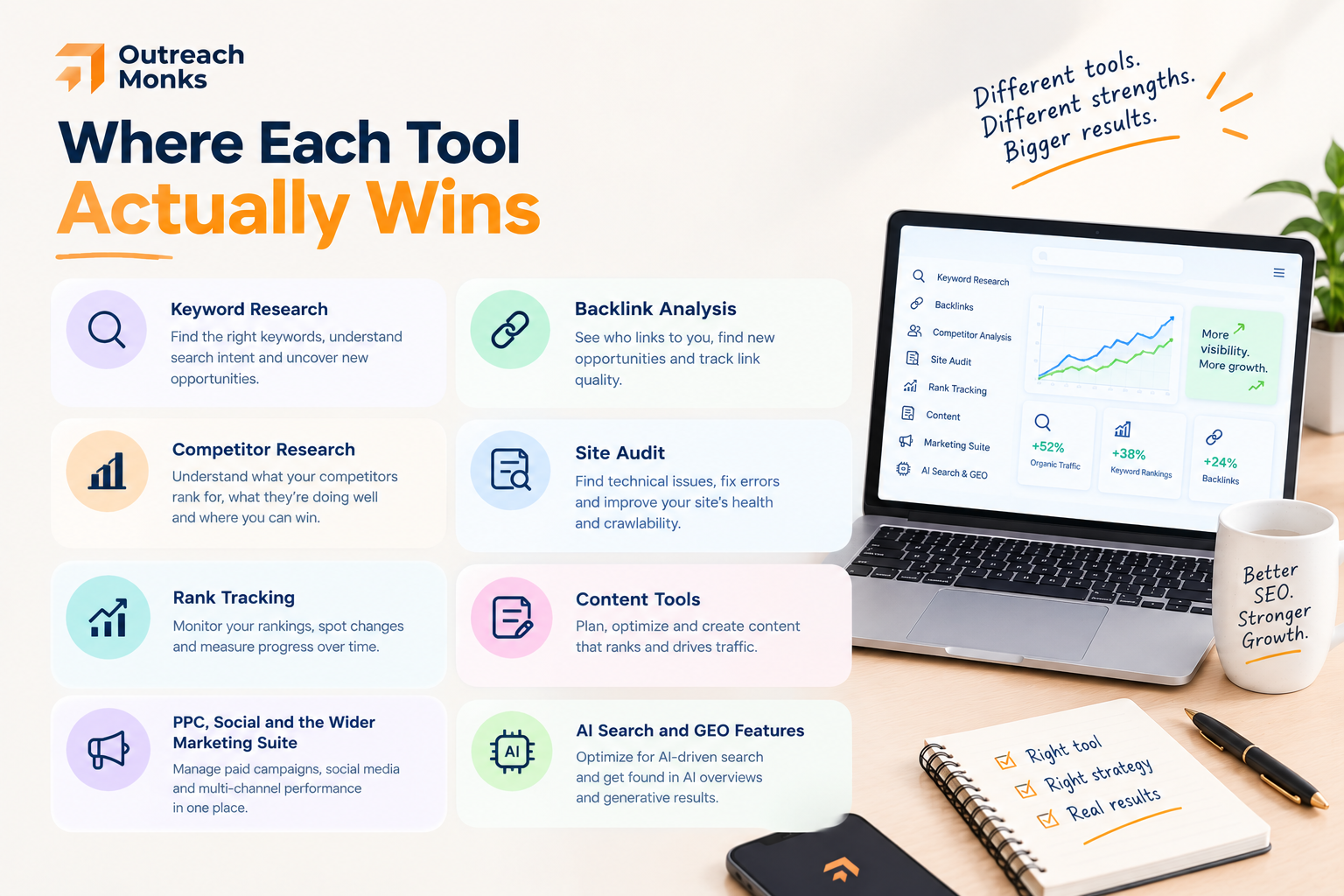
We compared both tools across ten categories that actually affect day to day work, not just feature lists. Here is where each one pulls ahead, and where the gap barely matters.
1. Keyword Research

Semrush’s Keyword Magic Tool is the larger playground. You get intent labels on every keyword, clustering that holds up on big exports, and historical volume on the higher plans so you can see whether a term is dying or growing. For building out a topical map across hundreds of terms, that structure saves real hours.
Ahrefs Keywords Explorer is less sprawling and more opinionated. Two metrics do a lot of work here. Parent Topic tells you whether a keyword genuinely needs its own page or whether it will be picked up by a broader article you are already planning, which quietly prevents a lot of cannibalisation. Clicks shows estimated clicks rather than searches, which is the more honest number now that so many results are answered on the SERP itself.
Volume figures differ between the two, sometimes by a lot on low volume terms. Neither is wrong so much as differently modelled.
Verdict: a genuine tie, split by job. Semrush if you are planning content at scale and want intent and clustering. Ahrefs if you are deciding, keyword by keyword, whether a page is worth writing.
2. Backlink Analysis

This is the category people actually argue about, so it is worth separating two different questions: who has more links, and who makes those links useful.
On raw size, Semrush claims the larger backlink index and Ahrefs claims the larger set of referring domains. Both numbers are self reported and the two companies count differently, so treat the gap as noise rather than a verdict.
On usefulness, Ahrefs wins for us, and not by a small margin. The referring domains report, the filters, and Link Intersect form a prospecting workflow rather than a data dump. You can go from “who links to my three competitors but not to me” to an exportable, deduplicated target list in a couple of minutes. Semrush’s Backlink Gap gets to a similar answer with more friction.
Semrush pulls ahead on hygiene. Its Backlink Audit and toxicity scoring give you a structured way to review a messy profile, which matters if you have inherited a site with a history of unnatural backlinks. Treat the toxicity score as a shortlist for human review rather than a verdict, because automated scoring flags plenty of harmless links. Both tools report lost links, which is how most teams first notice link decay eating into a profile they paid for.
Verdict: Ahrefs, clearly, for research and prospecting. Semrush if auditing and cleaning up an existing profile is the bigger part of your job.
3. Competitor Research
Both estimate competitor traffic, both show top pages, both do content and link gap analysis. The difference is scope.
Semrush reaches further out. Traffic Analytics covers channel mix, audience overlap and visit behaviour, and the market analysis tools let you size a category rather than just a competitor. If someone is going to ask you for a competitive landscape slide, Semrush gets you there faster.
Ahrefs goes deeper on the part that turns into work. Its top pages view, with traffic value and the keywords driving each page, is the cleanest way we know to answer “which single page of theirs should we be worried about”.
Verdict: Semrush for market level research and anything client facing. Ahrefs for page level competitive work.
4. Site Audit

Semrush’s Site Audit is better at teaching. Issues come with plain language explanations of why they matter, which makes the report usable by a client or a developer who is not an SEO. Its internal linking reports are genuinely helpful for spotting orphan pages and weak internal linking.
Ahrefs wins on scale and speed, and the current plan limits make that concrete. Ahrefs Advanced allows up to 250,000 pages per project with 1.5 million crawl credits a month. Semrush Advanced tops out at 40 monitored websites with correspondingly tighter crawl allowances. If you manage large ecommerce catalogues or news archives, that gap decides the argument, and it is also where crawl budget problems actually show up.
Verdict: Ahrefs for large sites and frequent crawls. Semrush if the audit has to be readable by people outside the SEO team.
5. Rank Tracking

Semrush tracks daily on all current plans, from 500 keywords on the SEO and Starter tiers up to 5,000 on Advanced. Its local tracking is the stronger offering, with granular location targeting and device splits, plus SERP feature tracking so you can see when a featured snippet or AI Overview has taken your clicks.
Ahrefs Rank Tracker is dependable and clearly presented, with 750 tracked keywords on Lite, 2,000 on Standard and 5,000 on Advanced. It gives you more tracked keywords than Semrush at the equivalent price point. What it gives you less of is local granularity.
Verdict: Semrush, mainly on local and SERP feature depth. Ahrefs if you simply want more keywords for the money.
6. Content Tools
Semrush treats content as a workflow. Topic Research, SEO Content Template, the writing assistant and the On Page SEO Checker form a chain from idea to brief to optimised draft. Pro+ and above add content optimisation and keyword cannibalisation analysis, which is the sort of feature you only miss once your site is a few hundred pages deep.
Ahrefs is lighter here by design. Content Explorer is excellent for finding what has earned links and shares in a topic, which is a different and often more valuable question than what is optimised. AI Content Helper exists, with Content Kit available as an add on from $99 per month, but content is not where Ahrefs is trying to win.
Verdict: Semrush, comfortably, if you have writers to support. Ahrefs if you want content research rather than content production.
7. PPC, Social and the Wider Marketing Suite
There is no contest. Semrush has advertising research, keyword gap analysis for paid search, ad copy history, display advertising research, social media posting and tracking, and now sits inside Adobe’s marketing ecosystem following the acquisition that closed on 28 April 2026 at $12.00 per share in cash. Ahrefs does not seriously compete in any of this and has never claimed to.
This matters only if you will use it. Paying for a social scheduler you ignore is not breadth, it is overhead.
Verdict: Semrush, by default, but only count it if paid search or social is genuinely part of your remit.
8. AI Search and GEO Features
This is the category that changed most in 2026, and it is where the pricing comparison gets interesting. As zero click searches and AI generated answers absorb more queries, being cited inside those answers has become a measurable goal rather than a theory.
Semrush has pushed AI search tracking into its core plans. Prompt tracking is included across the current tiers: 50 daily prompts on Starter, 100 on Pro+ and 200 on Advanced, alongside AI visibility reporting and AI sentiment tracking. The $139 SEO plan includes AI search monitoring too. There is also MCP access on Starter and above, which lets you query your Semrush data from an AI assistant directly.
Ahrefs has built the deeper instrument and priced it separately. Brand Radar tracks AI Overviews, AI Mode, ChatGPT, Gemini, Perplexity and Copilot, with Custom Prompts also covering Claude. It reports mentions, citations, AI share of voice and estimated impressions, with YouTube, TikTok and Reddit visibility in beta. Custom Prompts are bundled into paid plans but with small daily quotas: five a day on Lite, ten on Standard, twenty on Advanced. The AI Visibility Index, which is the version with real coverage, starts at $199 per month on top of your subscription.
The practical consequence: if AI visibility tracking is a 2026 priority, Semrush is the cheaper route and Ahrefs is the more thorough one. Either way, the measurement is the easy half. Getting cited by an AI system means being referenced across the sources those systems read, which is why brand mentions have moved from a nice to have into a core part of the work.
Verdict: Semrush on value, Ahrefs on depth. If you want the best AI visibility data available and can absorb $199 a month for it, Brand Radar is the stronger product.
9. Reporting, Seats and Agency Features
For agencies this category often outranks data quality, because it determines what you can actually deliver and what it costs you per client.
Semrush includes client reporting, with scheduled and branded reports, plus a Base Report add on at $10 per month and a Pro Report at $20. Extra users start at $45 per month. Advanced adds API access and SEO share of voice reporting.
Ahrefs sells Report Builder as a $99 per month add on covering 50 reports and 500 widgets. Its seat pricing is the detail most comparisons skip, and it works in the opposite direction to what you would expect: extra users cost $40 per month on Lite, $60 on Standard, $80 on Advanced and $100 on Enterprise. The more you spend on your base plan, the more each additional person costs you.
Neither tool does white label fulfilment, only white label reporting. If you resell SEO, the gap between a branded report and the work behind it is still yours to fill, which is why white label link building and SEO reseller arrangements exist alongside these platforms rather than instead of them.
Verdict: Semrush, on seat economics and built in reporting. The gap widens with every person you add.
10. Usability and Learning Curve

Ahrefs is faster to think in. Fewer menus, fewer modules, less cross selling, and reports that load quickly and say what they mean. New team members tend to be productive in it within a day or two.
Semrush is more powerful and more work. There are dozens of tools, several of which overlap, and the interface actively promotes features you are not subscribed to. The payoff is real once you know your way around, but expect a slower first month and budget time for training if you are onboarding a team.
Verdict: Ahrefs, and this is worth more than it sounds. A tool your team opens daily beats a more capable one they avoid.
Data Accuracy: Stop Reading Reviews, Run This Test
Almost every comparison says both tools are “broadly accurate” and moves on. That is not useful, because accuracy is not a property of the tool. It is a property of the tool in your niche, in your country, for your site.
Here is how little weight the published figures deserve. Three comparison articles currently ranking for this query give three different sizes for Semrush’s keyword database: 26.7 billion, 27.3 billion and 28.4 billion. They are all quoting the same vendor in the same year. The numbers move because the vendors restate them and because writers copy each other.
Why the two tools disagree
Traffic estimates are models, not measurements. Each vendor maintains its own keyword database, its own clickstream panel, and its own click through rate curves. Three differences compound:
- Keyword coverage. A tool can only estimate traffic from terms it tracks. Both miss enormous amounts of long tail, and they miss different parts of it.
- Click modelling. Position three on a SERP with an AI Overview and four ads earns a fraction of position three on a clean SERP. Modelling that well is hard and both are approximating.
- Panel composition. Clickstream panels skew by country, device and demographic. This is why a tool can be close on your US numbers and badly off on your German ones.
Neither should ever be treated as truth. The only number that is not an estimate is your own.
The 15 minute accuracy test
Run this on your own site during a trial. It is the only accuracy comparison that tells you anything, and it uses Google Search Console as the reference because it reports what actually happened rather than what a model predicts.
- Get your baseline. In Search Console, open the Performance report, set the date range to the last 28 days, and note total clicks and total impressions. Export the top 100 queries with their clicks and average positions.
- Compare the traffic estimate. Run your own domain in each tool, filtered to your main country. Compare each tool’s monthly organic traffic estimate to your actual 28 day click total. Do not expect a match. What you are looking for is which tool is wrong in a smaller and more consistent direction, because a tool that is reliably 40 percent low is more useful than one that swings.
- Test the rankings, which is the part that matters. Pick ten queries where Search Console shows your average position between 1 and 10. Check each tool’s reported position for those same ten keywords, same country, same day. Count how many land within two positions of your Search Console figure. The tool with more hits is the more accurate one for your niche.
Two things usually fall out of this. First, Search Console will show you queries that neither tool knows you rank for, which is a useful reminder that the long tail is bigger than any tool’s picture of it. Second, the winner is often not the tool with the bigger advertised database.
Do this before you commit to an annual plan, not after.
Pricing and What It Actually Costs
Headline prices are close enough to be unhelpful. The real difference shows up in seats, limits and add ons.
Current Plans Compared
| Plan or Cost Item | Semrush | Ahrefs |
|---|---|---|
| Cheapest paid | $139/mo SEO plan: 5 sites, 500 daily keywords | $29/mo Starter: limited data access |
| Entry tier | $199/mo Starter: 5 sites, 500 keywords, 50 daily prompts, MCP access | $129/mo Lite: 5 projects, 750 keywords, 100k crawl credits |
| Mid tier | $299/mo Pro+: 15 sites, 1,500 keywords, 100 prompts, historical data | $249/mo Standard: 20 projects, 2,000 keywords, 500k crawl credits |
| Top standard tier | $549/mo Advanced: 40 sites, 5,000 keywords, 200 prompts, API | $449/mo Advanced: 50 projects, 5,000 keywords, 1.5M crawl credits |
| Enterprise | Custom | $1,499/mo, annual commitment |
| Annual discount | About 17 percent | About 17 percent |
| Extra seats | From $45/mo | $40 Lite, $60 Standard, $80 Advanced, $100 Enterprise |
| Free trial | 7 days | None listed; $29 Starter instead |
| Free tier | 1 demo project, 10 reports per day | Webmaster Tools: own sites, 5k crawl credits per project |
| AI search add on | Prompt tracking included in paid plans | AI Visibility Index from $199/mo |
| Other add ons | Lead gen $90/mo, reports $10 to $20/mo | Content Kit $99/mo, Report Builder $99/mo, Project Boost $20 to $200/mo |
What it costs a real team
This is the comparison almost nobody publishes, and it is the one that decides the invoice. Figures are monthly list prices at the plan each team size realistically needs.
| Team | Semrush plan | Semrush cost | Ahrefs plan | Ahrefs cost |
|---|---|---|---|---|
| 1 person | SEO, 1 seat | $139 | Lite, 1 seat | $129 |
| 3 people | Pro+ plus 2 seats | $389 | Standard plus 2 seats | $369 |
| 3 people with AI tracking | Pro+ plus 2 seats | $389 | Standard, 2 seats, AI Index | $568 |
| 10 people | Advanced plus 9 seats | $954 | Advanced plus 9 seats | $1,169 |
| 10 people with AI tracking | Advanced plus 9 seats | $954 | Advanced, 9 seats, AI Index | $1,368 |
What Ahrefs gives you for that extra money at the top end is more projects and dramatically higher crawl limits. If you audit large sites, that is a fair trade. If you do not, you are paying for headroom you will not touch.
Free Access, Compared Honestly
Ahrefs Webmaster Tools is the more generous free offer for your own sites. Verify ownership and you get Site Audit with 5,000 crawl credits per project per month, Site Explorer limited to 1,000 backlinks and keywords visible at a time, Web Analytics, and one AI Content Helper document a month, across unlimited verified sites. What you do not get is Keywords Explorer, Rank Tracker, Content Explorer, or the ability to look at any site you do not own, which rules out competitor research entirely.
Semrush’s free plan gives one project and ten reports a day across its tools. Fewer reports, but those ten can point at competitors, which makes it the better free option for research and the worse one for monitoring your own site.
Who Should Choose Which Tool ?
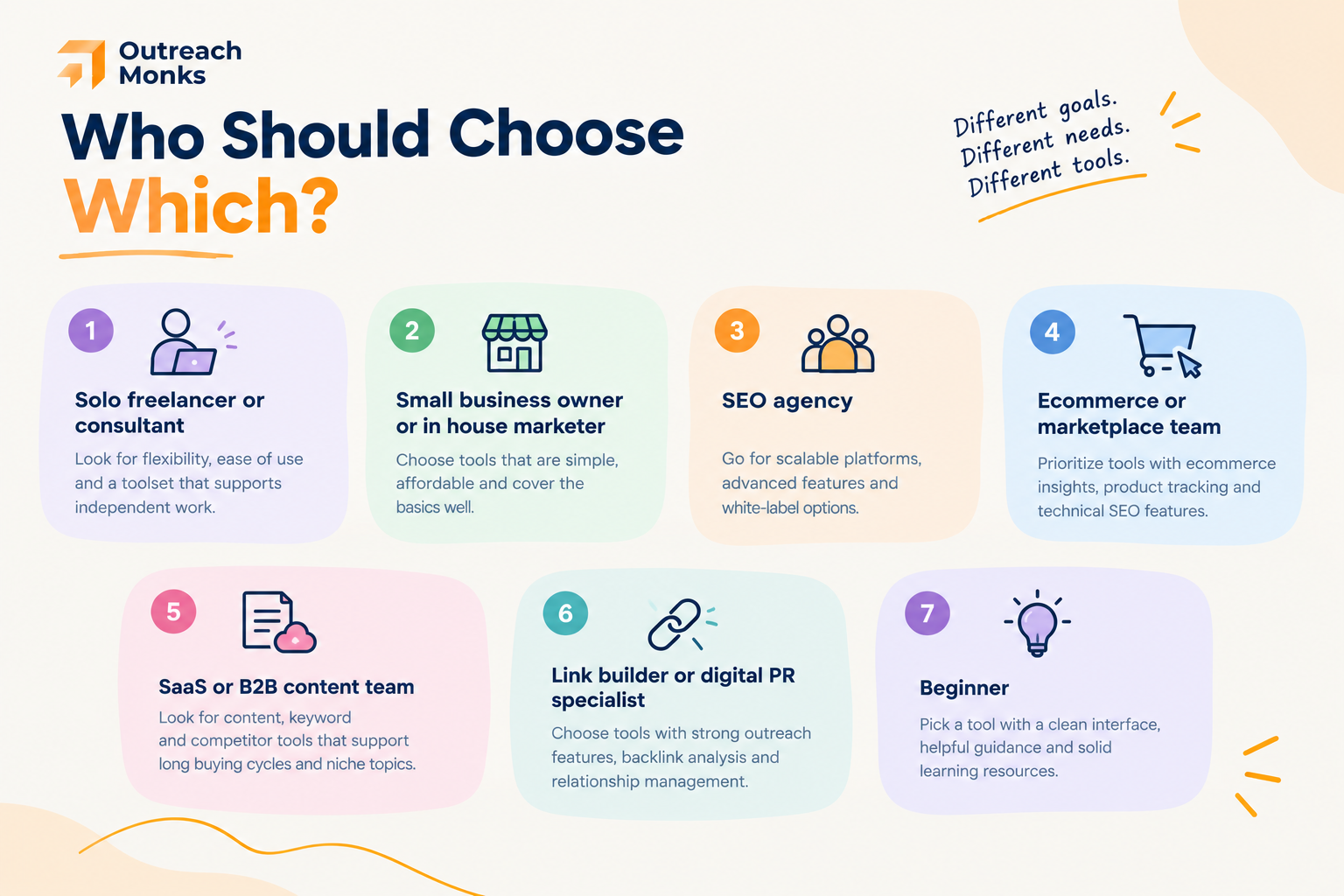
Each pick below comes with the reason it matters to that specific role, because “Semrush for X, Ahrefs for Y” without a reason is the thing most of these articles get wrong.
1. Solo freelancer or consultant
Ahrefs Lite at $129 per month. One seat is all you need, so Semrush’s cheaper seats are irrelevant to you, and Ahrefs gives you more tracked keywords and a faster interface for less money. Start on the $29 Starter plan for a month to check the data suits your niche before committing.
2. Small business owner or in house marketer
Semrush, at the $139 SEO plan. You are likely to need rank tracking, a readable site audit and some content guidance more than you need a deep backlink index, and Semrush’s explanations make the reports usable without an SEO on staff. If you are working through this yourself, our guide to DIY SEO pairs well with that plan.
3. SEO agency
Semrush, and the reason is arithmetic rather than features. Seats are the dominant cost once you pass two people, and Ahrefs charges more per seat as you move up its plans. At ten people the difference is roughly $2,600 a year, before AI visibility. Built in client reporting closes the gap further, since Ahrefs charges $99 a month for Report Builder.
The exception: if your agency is a link building or digital PR specialist, buy Ahrefs for the team that does prospecting and put everyone else on Semrush. Splitting by function is usually cheaper than forcing one tool on both.
4. Ecommerce or marketplace team
Ahrefs, on crawl limits. Large catalogues generate faceted URLs, variant duplication and thin category pages at a scale that eats page allowances, and Advanced gives you 250,000 pages per project. The caveat is that the audit will find more than you can fix, so pair it with a prioritised plan and dedicated ecommerce link building for the category pages that actually drive revenue.
5. SaaS or B2B content team
Semrush. Intent labels, topic clustering, cannibalisation analysis on Pro+ and the content brief workflow do more for a team publishing weekly than a deeper backlink index does. Add Ahrefs later, when link acquisition becomes the constraint instead of content production.
6. Link builder or digital PR specialist
Ahrefs, without hesitation. Link Intersect, the referring domains filters and the export workflow are built for exactly this job and will save you hours every week against Semrush’s equivalent. Pair it with Content Explorer to find the publications that reliably earn links in your niche, then turn that list into actual placements through guest posting and niche edits.
7. Beginner
Ahrefs Starter at $29 per month, or Ahrefs Webmaster Tools for free on your own site. Both are cheap ways to learn what the metrics mean before you can tell which platform suits you. Buying a $199 plan in month one usually means paying for features you will not open until month six.
Should You Run Both?
Plenty of agencies do, and above a certain size it stops being indulgent. The usual split is Ahrefs for backlink research, prospecting and competitor page analysis, Semrush for rank tracking, reporting, content workflows and AI visibility.
The honest threshold: running both only pays for itself when the time it saves exceeds its cost. For a team of three, Standard plus Pro+ with seats comes to roughly $758 a month. That is justifiable if link building is a revenue line and you are billing for the reporting. It is hard to justify for a single site.
If both is out of reach, two cheaper combinations work well. One paid platform plus Ahrefs Webmaster Tools free on your own sites covers most gaps for a small team. One paid platform plus Search Console, used properly, covers most gaps for a single site owner, and Search Console is the more accurate source for your own performance anyway.
Whichever you choose, connect Search Console to it. Both platforms are better with your first party data attached, and it keeps their estimates honest.
What Neither Tool Will Do For You
This is the part the feature tables leave out, and it is the most important paragraph in this article.
Both platforms are measurement instruments. Ahrefs will tell you that four competitors share 180 referring domains you do not have. Semrush will tell you that your authority gap is why you are stuck at position twelve. Neither will send a single email, negotiate a single placement, or write a single guest post. The link gap report is a diagnosis, not a treatment.
That gap between knowing and doing is where most SEO programmes stall. The data is cheap now, at $129 a month. The execution is the expensive, slow, human part: finding real sites with real traffic, pitching them, writing something worth publishing, and keeping the anchor profile natural while you do it at volume. That is the work we do at Outreach Monks through manual outreach, with every placement on a real site, no PBNs and no link farms, and live tracking in a shared sheet so you can see what landed. If you want the full picture rather than links alone, our SEO packages cover strategy, technical work and content alongside the link acquisition, and the results show what that looks like over time.
Use Ahrefs or Semrush to decide which links are worth having. Then someone has to go and get them.
Five Mistakes People Make Choosing Between Them
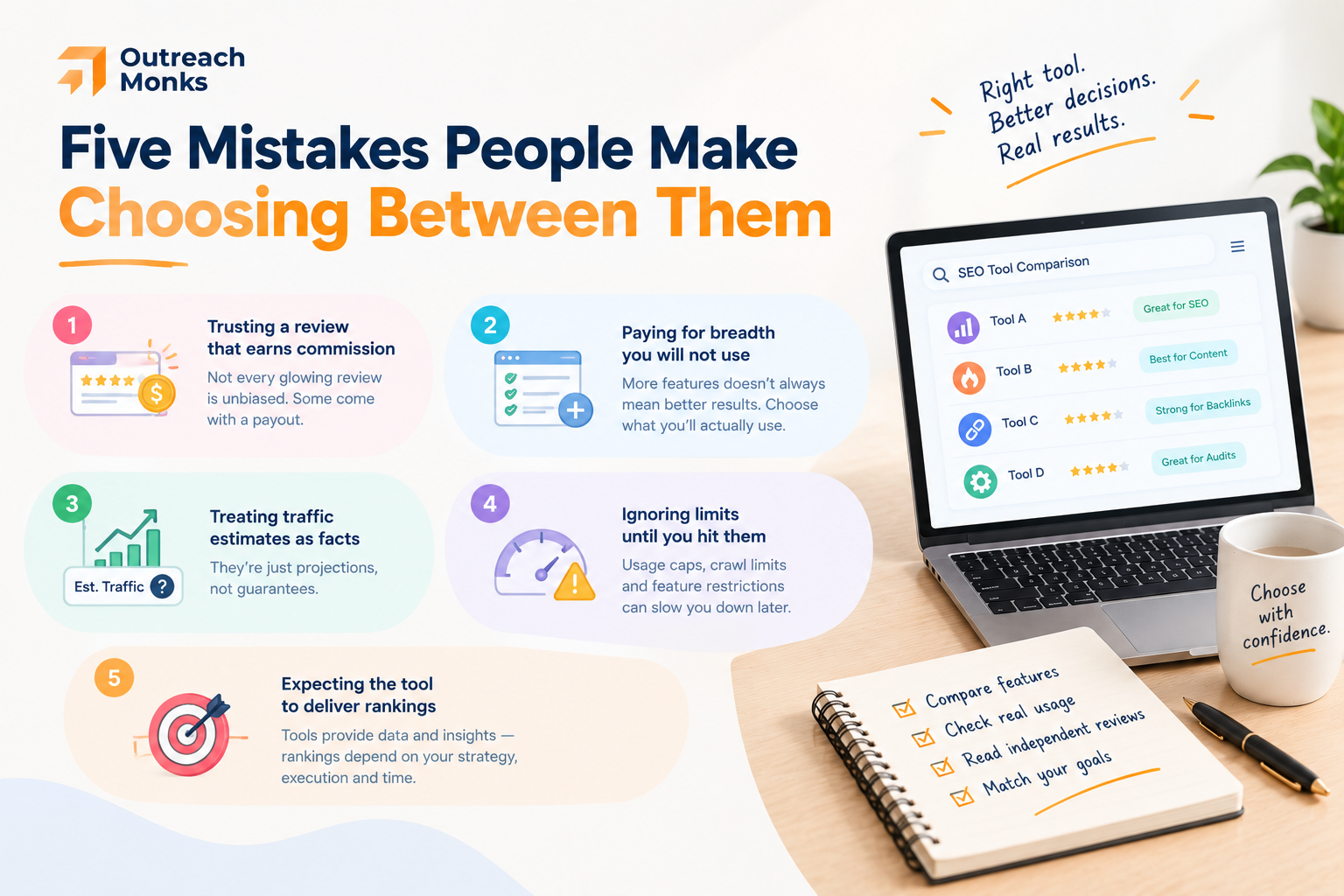
- Trusting a review that earns commission. Both companies run affiliate programmes, and the margins are good. If an article declares a decisive winner and links out with a tracking parameter, read the verdict as advertising. Check whether a disclosure exists.
- Paying for breadth you will not use. Semrush’s advertising and social toolkits are genuinely strong and completely worthless if nobody on your team runs ads. Count only the features that will appear in someone’s weekly routine.
- Treating traffic estimates as facts. Reporting a competitor’s estimated traffic to a client as though it were measured is how you lose credibility in one meeting. Say estimated, and say which tool produced it.
- Ignoring limits until you hit them. Seats, projects, tracked keywords, crawl credits and prompt quotas are where both platforms make their money. Work out what you need at the team size you expect in twelve months, not the one you have today.
- Expecting the tool to deliver rankings. A subscription is not a strategy. Both platforms will show you what to fix and neither will fix it, which is worth remembering before you blame the tool for a flat quarter.
On that last point, be as sceptical of a first page SEO guarantee as you would be of a tool that promised the same thing. What a platform can do is tell you what to work on next, which is why a plain SEO roadmap built from its data is worth more than the subscription itself.
Conclusion
There is no universal winner between Semrush and Ahrefs, but there are clear answers depending on your situation. For solo users or those on a small budget, Ahrefs is the better choice thanks to its cheaper entry point, faster interface, and more tracked keywords per dollar. Agencies with three or more people will generally get better value from Semrush because of its seat economics and built-in reporting. For link building or digital PR, Ahrefs stands out for its prospecting workflow, while content-led teams will benefit more from Semrush’s intent data, clustering, and cannibalisation analysis.
If you manage large websites, Ahrefs has the edge because of its higher crawl and page limits. For AI search visibility on a budget, Semrush is the more cost-effective option because prompt tracking is bundled into its paid plans, while teams without a strict budget may prefer Ahrefs Brand Radar for its deeper coverage at an additional $199 per month.
The best way to make the final decision, however, is to test both on your own data. Take a seven-day Semrush trial and an Ahrefs Starter month, run the 15-minute accuracy test on your own domain, and compare both platforms against your top three competitors. A week of real data from your own niche will tell you more about which tool fits your workflow than any comparison article, including this one.
Frequently Asked Questions
Is Semrush better than Ahrefs?
Neither is better across the board. Semrush is the broader platform, covering SEO, PPC, content, local and AI visibility, with cheaper extra seats. Ahrefs is the sharper SEO specialist, with a better backlink workflow, higher crawl limits and a faster interface. Teams of three or more usually land on Semrush for cost reasons; link builders usually land on Ahrefs.
Which is better for backlink analysis, Semrush or Ahrefs?
Ahrefs, for research and prospecting. Its referring domains reports, filters and Link Intersect turn competitor data into a usable target list faster than Semrush’s Backlink Gap. Semrush is the better choice if your main task is auditing and cleaning up an existing backlink profile, because its Backlink Audit and toxicity scoring give that work more structure.
Which is better for keyword research?
It depends on the task. Semrush gives you intent labels, clustering and historical volume, which suits planning content at scale. Ahrefs gives you Parent Topic and Clicks data, which suits deciding whether an individual keyword deserves its own page. Volume estimates differ between them, particularly on low volume terms, because each models search demand differently.
Is Semrush or Ahrefs better for agencies?
Semrush, in most cases, and the reason is seats. Extra users start at $45 per month on Semrush, while Ahrefs charges $40 on Lite rising to $100 on Enterprise. Client reporting is also included with Semrush, whereas Ahrefs sells Report Builder as a $99 per month add on. At ten users the difference runs to thousands of dollars a year.
Which is cheaper, Semrush or Ahrefs?
Ahrefs is cheaper for one person, at $129 per month on Lite against $139 for Semrush’s SEO plan, and it has a $29 Starter tier. Semrush becomes cheaper as the team grows, because its extra seats cost less and AI prompt tracking is bundled rather than sold as a $199 per month add on. Verify both on the vendors’ pricing pages before buying.
Which is more accurate, Semrush or Ahrefs?
Neither, reliably. Both traffic figures are model based estimates built on different keyword databases, clickstream panels and click curves, so they disagree and both differ from reality. The only way to answer this for your site is to compare ten of your own keyword positions in each tool against Google Search Console on the same day. Whichever matches more often is the more accurate one for your niche.
Do Semrush and Ahrefs track AI search visibility?
Both do, priced very differently as of October 2026. Semrush includes prompt tracking in its paid plans, from 50 daily prompts on Starter to 200 on Advanced, plus AI visibility and sentiment reporting. Ahrefs includes small Custom Prompt quotas in paid plans, from five a day on Lite, and sells its full AI Visibility Index from $199 per month. Ahrefs Brand Radar covers more platforms, including AI Overviews, ChatGPT, Gemini, Perplexity and Copilot.
Which is better for beginners?
Ahrefs. The interface is cleaner, there are fewer overlapping tools, and there is less cross selling to work around, so most people are productive within a couple of days. Semrush is more capable but takes longer to learn. If you are starting out, Ahrefs Webmaster Tools is free on your own verified sites and the $29 Starter plan is a low risk way to learn the metrics.
Can I use Semrush and Ahrefs together?
Yes, and many agencies do. The usual split is Ahrefs for backlink research and prospecting, Semrush for rank tracking, reporting, content and AI visibility. For a team of three, running both comes to roughly $758 per month at list price, so it only makes sense when the time saved exceeds the cost. For a single site, one platform plus Google Search Console is usually enough.
Do Semrush and Ahrefs offer a free trial?
Semrush offers a seven day free trial on its paid plans and a free tier with one project and ten reports a day. Ahrefs does not list a general free trial; instead it offers a $29 per month Starter plan and Ahrefs Webmaster Tools free on sites you verify as your own. Check both vendors’ current terms before signing up, since trial offers change.