
Here is a test you can run in the next sixty seconds. Open ChatGPT, Gemini, or Perplexity right now and ask it to recommend the best product in your category. Is your brand in the answer? Or is it a list of competitors you have never once lost a deal to?
That answer is your new rankings page. For twenty years, the game was ranking on Google and counting clicks. Today, a growing share of your buyers never reach that page. They ask an AI assistant and act on the three or four brands it names. If you are not one of them, you are invisible, and you will not even see the traffic you lost, because there was never a click to track.
That is what AI visibility tools solve. They track how often your brand shows up in AI answers, which questions trigger you, which competitors beat you to the mention, and which sources the models trust when they build a reply.
We live inside these platforms for clients at Outreach Monks, so this guide reads like a colleague’s briefing: what each tool is genuinely good at, what it costs, where it falls short, and the thing almost every other list skips, which is how these tools actually collect their data and why that should change how much you trust the number on the dashboard.
How We Evaluated the Best AI Visibility Tools
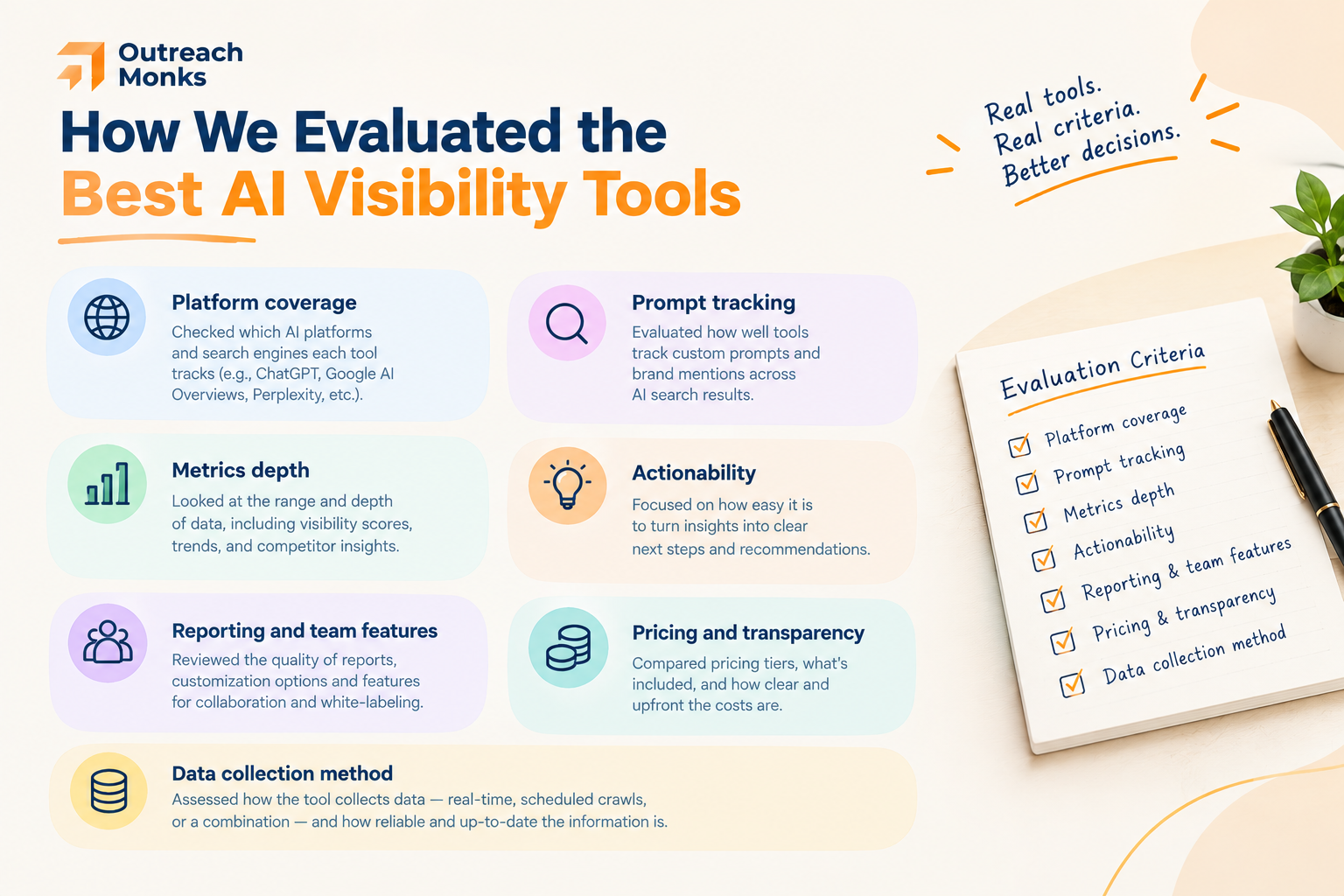
We judged every tool on seven things. The first six are the usual suspects. The seventh is the one that separates a number you can trust from a number that just looks confident.
| Sr. No. | Criteria | What We Looked For |
|---|---|---|
| 1 | Platform coverage | Does it track where buyers actually ask: ChatGPT, Google AI Overviews and AI Mode, Gemini, Perplexity, Copilot, and increasingly Claude? |
| 2 | Prompt tracking | How many prompts can you monitor, how often are they refreshed, and can you track your own buying-intent questions rather than only suggested ones? |
| 3 | Metrics depth | Beyond a vanity score: mentions, citations, share of voice, sentiment, and where in the answer you appear. Named first is not the same as buried in paragraph four. |
| 4 | Actionability | Does it explain why you’re missing and what to do about it, or just hand you a flat line? |
| 5 | Reporting and team features | White label reports, client workspaces, exports and API access, which matter enormously for agencies. |
| 6 | Pricing and transparency | What you pay, what the limits are, and whether the price is published at all. |
| 7 | Data collection method | How the tool actually gets its answers, which almost no comparison explains. This is the difference between measurement and guesswork, explained below. |
The one criterion nobody talks about: how the data is collected
AI answers are not fixed like a Google ranking. Ask the same model the same question twice and you can get two different answers, with different brands named. So every AI visibility tool has to sample, and how it samples decides how much you can trust it. There are three broad approaches, and it is worth knowing which one you are paying for.
- Live prompting. The tool sends your prompts to the live models on a schedule and reads what comes back. This is the closest thing to what a real user sees, but a single run is a snapshot, so good tools run each prompt many times and average the result.
- API based sampling. The tool queries the models through their APIs. It scales cleanly and is consistent, but API output can differ from what a person sees in the consumer app, especially where live web browsing is involved.
- Inferred or panel data. The tool estimates visibility from other signals rather than reading answers directly. It is rarer and should be treated as the loosest estimate of the three.
When a tool tells you that you have a 32 percent share of voice, the honest follow up question is: across how many prompts, run how many times, on which platform, in which country, and on what date? The best tools answer that without flinching. Keep it in mind as you read the list.
The 10 Tools, Ranked by What They’re Actually Good For
Five dedicated AI visibility platforms, four SEO suites that have built AI tracking in, and one free baseline that every single person reading this should set up today. Pricing is indicative, so treat the numbers as a guide and verify before you buy.
1. Profound – The Deep End for Enterprise Teams
Best for: enterprise brands and agencies that need depth and are not shopping on price.
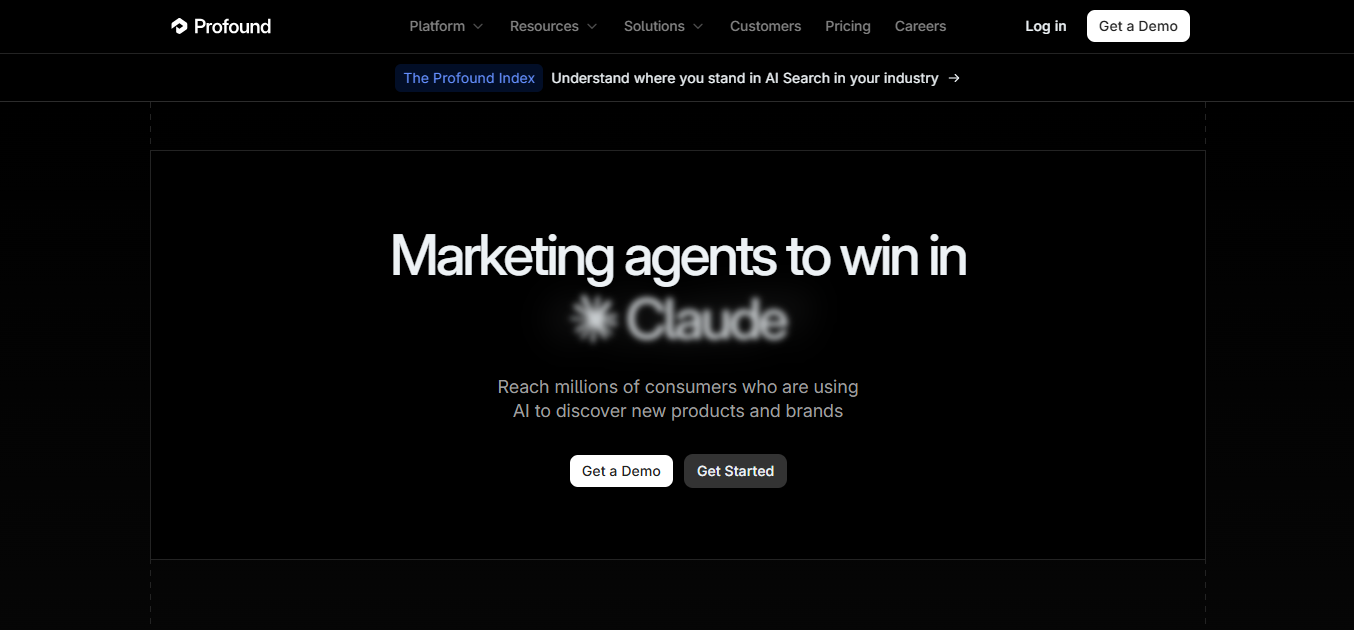
Profound is the name that comes up first in most serious conversations about this category, and for good reason. It tracks brand presence across the major AI platforms, breaks down the exact prompts and topics that trigger you or your competitors, and goes a level deeper than most by showing which sources the models pull from when they build an answer, so you can see the pages doing the citing rather than just the final result. It also reports on how AI crawlers are hitting your own site.
Watch out for: it is built for bigger budgets, with paid plans commonly cited starting around $99 per month on annual billing and rising quickly into several hundred a month, plus custom enterprise pricing. For a solo site it is overkill. For a brand with real revenue riding on AI visibility, it is often the one people end up on.
Indicative price: from roughly $99/mo (annual) to custom enterprise.
2. Peec AI – Serious Tracking Without the Enterprise Price Tag
Best for: in house marketing teams that want serious prompt level tracking without enterprise pricing.
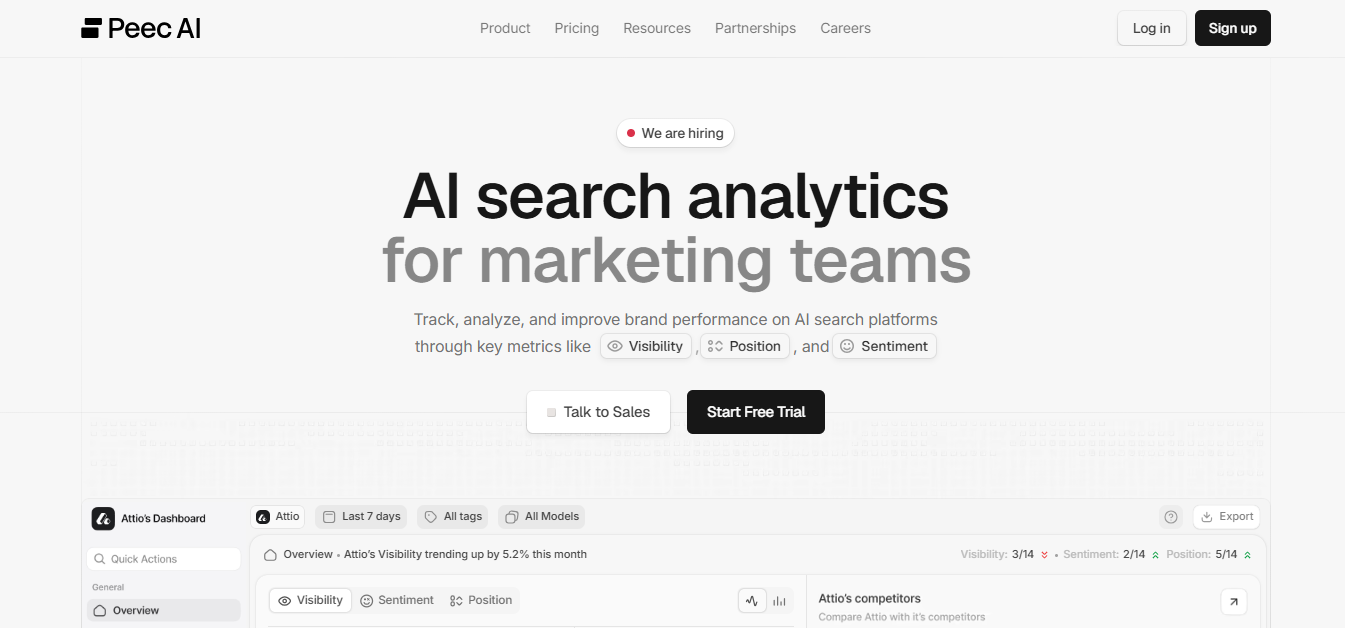
Peec has become a favourite of lean teams because it does the core job well and shows its working. You track a set of prompts, see your visibility and share of voice against named competitors over time, and get a clear view of which answers mention you and which sources they lean on. The interface is quick to read, which matters when you are checking it weekly rather than living in it.
Watch out for: it is focused on tracking and competitive benchmarking rather than a sprawling optimisation suite, so you still own the work of acting on what it finds. Pricing is typically quoted from around 89 euros per month for the entry plan.
Indicative price: from about €89/mo (roughly $95), with annual discounts.
3. Otterly.AI – Where Most People Should Actually Start
Best for: freelancers, small teams and agencies who want a real entry price, not a “contact sales” wall.
Otterly is the easiest way into this category. It monitors how your brand and your chosen prompts show up across AI search, tracks mentions, links and sentiment, and does it from a starting tier that most budgets can absorb. If you have been meaning to start measuring AI visibility but every tool you looked at wanted a four figure annual commitment, this is where you begin.
Watch out for: the cheapest tier is genuinely entry level, with limits on prompts and refresh frequency, so fast growing teams will outgrow it. Treat it as the on ramp.
Indicative price: from about $29/mo (Lite) up to custom enterprise.
4. AthenaHQ – Tracking That Also Tells You What to Fix
Best for: teams that want tracking and a pointed view of what to fix next.
AthenaHQ leans harder into the optimisation side than most pure trackers. Alongside the usual visibility and share of voice reporting, it works to surface the gaps and the content moves that would help you get cited more often, which is the question most teams actually care about once they have seen their flat line. A free entry point and a credit based model make it approachable to try.
Watch out for: the credit model means heavy use climbs in cost, and the higher tiers are not cheap. Map your prompt volume to the credits before you commit.
Indicative price: free tier available, then credit based paid plans; confirm current tiers on the vendor page.
5. Scrunch AI – For Brands Thinking Past the Scoreboard
Best for: enterprise brands thinking about the whole AI brand experience, not just the scoreboard.
Scrunch sits at the more strategic, enterprise end. As well as tracking how you appear in AI answers, it focuses on how AI agents and crawlers experience your site and whether your content is readable and citable by them in the first place, which is a genuinely different and forward looking angle. If your concern is not only “are we mentioned” but “can the machines even parse us,” this is the one to look at.
Watch out for: it is pitched at larger organisations, pricing is generally custom rather than published, and it is more than a small team needs.
Indicative price: custom; aimed at mid market and enterprise.
SEO Suites That Added AI Tracking
If you already pay for an SEO platform, check what it now includes before you buy a second subscription. The major suites have all moved into AI visibility, and for many teams the built in version is enough.
6. Semrush – One Login, One Invoice
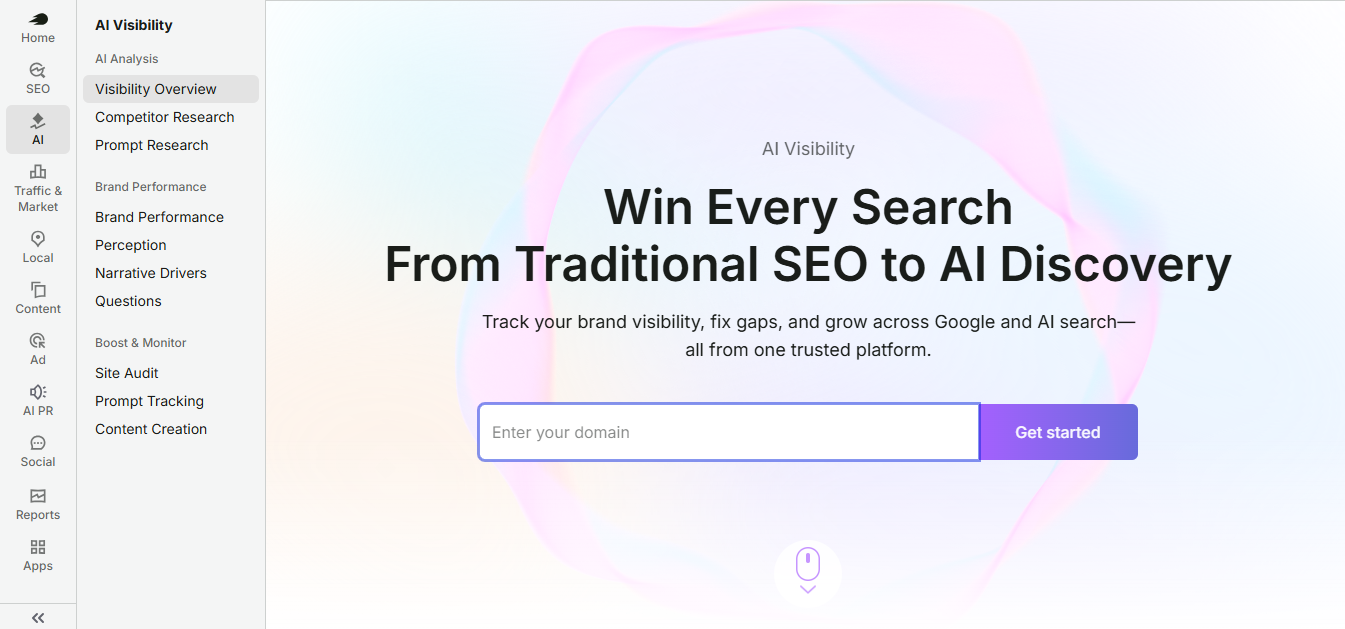
Best for: teams that want AI tracking inside the SEO suite they already use.
Semrush has folded AI search tracking into its core plans rather than selling it separately. You get prompt tracking, AI visibility reporting and AI sentiment tracking alongside the keyword research, rank tracking and site audit you were already paying for. For a team that wants one login and one invoice, the bundling is the whole point.
Watch out for: prompt allowances are tiered, and the deepest AI features sit on the higher plans. It is broad rather than specialist.
Indicative price: AI tracking included in paid plans, which start at $139/mo; higher tiers raise the daily prompt limits.
7. Ahrefs Brand Radar – The Widest Net You Can Buy
Best for: teams that want deep AI platform coverage from a tool they already trust for backlinks.
Brand Radar is Ahrefs’ AI visibility product, and its coverage is among the widest, spanning AI Overviews, AI Mode, ChatGPT, Gemini, Perplexity and Copilot, with Claude supported through custom prompts. It reports mentions, citations, AI share of voice and estimated impressions. Small prompt quotas come bundled into paid Ahrefs plans, which is a cheap way to dip in.
Watch out for: the version with real coverage, the AI Visibility Index, is a paid add on starting around $199 per month on top of your subscription. The bundled quotas are tiny.
Indicative price: tiny quotas bundled in paid plans; AI Visibility Index add on from $199/mo.
8. SE Ranking – AI Tracking for the Budget Conscious Agency
Best for: budget conscious agencies that want AI tracking inside an affordable full suite.
SE Ranking has long been the value pick among all in one SEO suites, and it has added AI visibility tracking to the mix. For an agency that wants rank tracking, audits, reporting and AI monitoring under one affordable roof, with white label reporting built in, it is a sensible consolidation play rather than stacking a specialist tool on top.
Watch out for: the AI tracking is newer and less deep than the dedicated platforms. Confirm the current prompt limits and platform coverage for the plan you are considering.
Indicative price: AI visibility available within SE Ranking’s suite; verify the current plan and any add on cost.
9. Nightwatch – Built for Teams Who Care About Location

Best for: rank tracking teams that want AI and LLM visibility with strong geographic granularity.
Nightwatch built its reputation on precise, location level rank tracking, and it has extended that into tracking brand visibility across AI and LLM answers. If you care about how visibility differs by city or region, its geo granularity is a real strength that the newer dedicated tools often lack.
Watch out for: it comes at this from a rank tracking heritage, so the AI reporting is less specialised than a purpose built platform. Check that its AI coverage matches the models your audience uses.
Indicative price: subscription based, positioned affordably; confirm the current AI tracking tier on the vendor page.
The Free Baseline Everyone Should Use
10. Google Search Console plus manual prompt testing
Best for: absolutely everyone, as a starting point and a reality check.
Before you pay for anything, do two free things. First, connect Google Search Console, which now surfaces some AI Overview and AI Mode appearances and is the only tool here reporting on what actually happened rather than a model’s estimate. Second, build a list of your twenty most important buying intent questions and run them by hand through ChatGPT, Gemini and Perplexity once a week, logging whether you appear and who beats you.
Watch out for: it does not scale, it is manual, and it will not give you a tidy share of voice chart. But it costs nothing, it teaches you what good prompts look like, and it keeps every paid tool honest. Start here, then upgrade when the manual work gets painful.
AI Visibility Tools: Quick Comparison
The shortlist side by side. Pricing is indicative and simplified, so read it as a starting point rather than a quote.
| Tool | Best For | Standout Strength | Indicative Price |
|---|---|---|---|
| Profound | Enterprise and agencies | Deep source and crawler analysis | From ~$99/mo to custom |
| Peec AI | In house teams | Clean prompt and competitor tracking | From ~€89/mo |
| Otterly.AI | Small teams, freelancers | Lowest real entry price | From ~$29/mo |
| AthenaHQ | Tracking plus fixes | Optimisation guidance, free tier | Free tier, then credits |
| Scrunch AI | Enterprise brand experience | AI crawler and readability focus | Custom |
| Semrush | One suite, one invoice | AI tracking bundled into SEO suite | In plans from $139/mo |
| Ahrefs Brand Radar | Wide platform coverage | Broadest AI platform tracking | Add on from $199/mo |
| SE Ranking | Budget agencies | AI tracking in an affordable suite | Within suite; verify |
| Nightwatch | Geo granular tracking | Location level AI visibility | Subscription; verify |
| Search Console + manual | Everyone, to start | Free, real data, keeps tools honest | Free |
Pricing, limits and platform coverage change often. Always confirm current details on the vendor’s own site before purchasing.
What Metrics Should You Track With AI Visibility Tools?
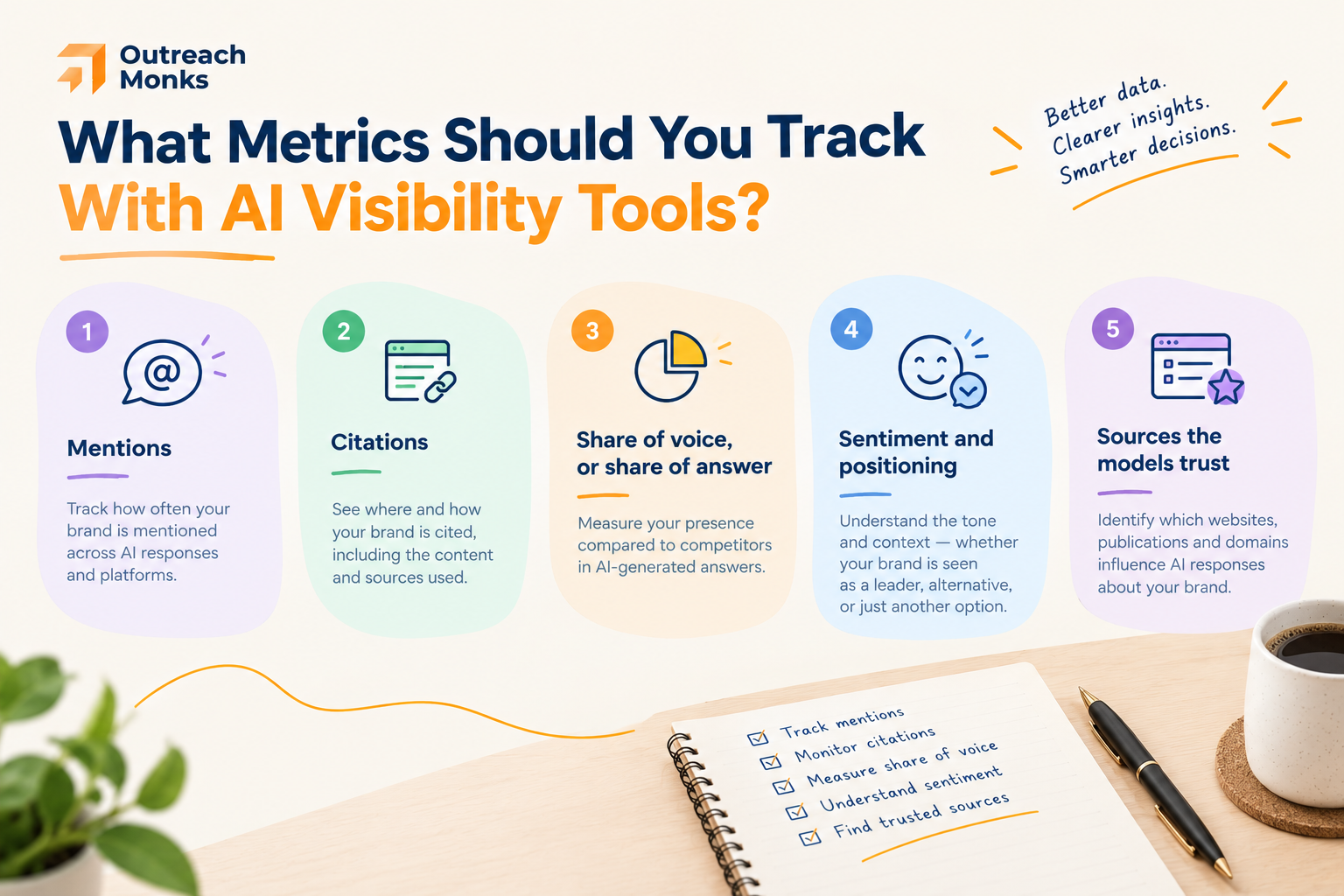
A visibility score on its own is a vanity number. These are the metrics that actually tell you something you can act on, and the vocabulary matters because vendors use different words for similar things.
1. Mentions
How often your brand name appears in AI answers for the prompts you track. This is the headline number, and the honest version of it is always tied to a prompt set and a number of runs. A mention rate with no context behind it is marketing, not measurement.
2. Citations
How often an AI links to one of your pages as a source. This is arguably more valuable than a mention, because a citation means the model trusted your content enough to point at it, and it can still send a real click. Track which of your pages get cited, because that tells you what the models consider authoritative.
3. Share of voice, or share of answer
Your presence versus named competitors across a set of prompts. This is the metric executives like, because it is a scoreboard. The trap is comparing share of voice numbers between tools, because each one uses a different prompt set and a different way of parsing answers, so the figures are not interchangeable. Pick one tool and watch the trend inside it.
4. Sentiment and positioning
Not just whether you are mentioned, but how. Are you described as the premium option or the cheap one, the leader or an also ran? And where in the answer do you land, named in the first line or buried at the bottom? Being mentioned last in a list of eight is very different from being the recommendation, and the better tools measure that prominence.
5. Sources the models trust
The most strategic metric of all: which websites the AI pulls from when it answers questions in your category. These are the pages you want to be mentioned on, reviewed on, or linked from, because they are the models’ reading list. This is exactly where traditional off page work meets the AI era, and why presence across trusted third party sites has become so valuable. We will come back to this, because it is the bridge from measuring the problem to fixing it.
How to Choose the Right AI Visibility Tool
Ignore the feature checklists for a moment and answer four questions. They will narrow ten tools down to two faster than any comparison table.
- What do you already pay for? If you have Semrush, Ahrefs or SE Ranking, start with the AI tracking already in your plan. Do not buy a second tool until you have outgrown the one you own.
- How many prompts do you actually need to track? A local business might need twenty. An enterprise with many product lines might need thousands. Prompt limits are where these tools price themselves, so count honestly before you look at tiers.
- Do you just need to measure, or do you need to act? If you want a dashboard to report upward, a tracker is enough. If you want to close the gap, favour a tool that tells you why you are missing, and pair it with the content and off page work that actually moves the needle.
- Are you an agency? Then white label reporting, client workspaces and per client pricing matter more than any single feature. A tool that looks great for one brand can become unaffordable or unmanageable across twenty clients.
One more thing, and it is the thing we say to every client: no tool improves your visibility. It measures it. Be exactly as sceptical of a platform that promises to “boost your AI rankings” as you would be of an agency selling a guaranteed first page ranking. What a good tool does is hand you an honest roadmap. Someone still has to drive.
Best AI Visibility Tool by Use Case
If you want to skip the deliberation, here is the short version by who you are.
- Freelancer or very small team: Otterly.AI to start paying, or Search Console plus manual testing if the budget is zero.
- In house marketing team: Peec AI for strong tracking at a fair price, or whatever is already bundled in your Semrush or Ahrefs plan.
- Budget conscious agency: SE Ranking, to keep AI tracking inside one affordable white label suite.
- Agency managing demanding clients: Profound for depth, or AthenaHQ when clients want the “what do we fix” answer alongside the chart.
- Enterprise brand: Profound or Scrunch AI, depending on whether your priority is tracking depth or the wider question of how AI agents experience your site.
- Local or multi location business: Nightwatch, for its geographic granularity.
- Already deep in an SEO suite: Semrush or Ahrefs Brand Radar, before you add anything new.
Conclusion
Here is the part the vendors are quieter about: every platform on this list only measures. Profound names the competitors beating you. Peec charts your flat share of voice. AthenaHQ points at the gaps. None of them will get you mentioned. That work happens off the dashboard.
And it is no secret how. AI models build answers from the sources they trust, so the brands that surface are the ones already written about and cited across the web your buyers read. The levers are the ones good SEO teams have always pulled, now aimed at a new target: earning genuine brand mentions on real, relevant sites through manual outreach and guest posting, writing pages a model can lift a clean answer from, and building the topical authority that makes you the obvious name to cite. It is the same force driving zero click searches upward.
Earning real mentions, one outreach email at a time, is what Outreach Monks does every day: manual outreach on real, relevant websites, backed by the case studies to prove it. Use these tools to find where you are invisible. Then go fix it.
Frequently Asked Questions
What Are AI Visibility Tools?
AI visibility tools track how often and how prominently your brand appears inside answers from AI systems such as ChatGPT, Google AI Overviews, Gemini and Perplexity. They monitor a set of prompts, report your mentions, citations and share of voice against competitors, and show which sources the models cite. In short, they are rank tracking for the AI era, where the answer has replaced the results page.
Can AI Visibility Tools Improve AI Search Performance?
Not on their own. AI visibility tools measure your performance; they do not improve it, in the same way a thermometer does not lower a fever. They tell you which questions you are missing from and which competitors are winning them. Improving actually comes from the work they point to: earning brand mentions on trusted sites, making your content clear and citable, and building topical authority so the models choose to reference you.
How do AI visibility tools track brand mentions in ChatGPT?
Most run your chosen prompts through the live models, or their APIs, on a schedule, then parse the answers to see whether your brand is named and how. Because AI answers vary between runs, good tools send each prompt many times and average the result. That is why the same brand can show a slightly different score across two tools: they use different prompts, run counts and parsing methods.
Are AI visibility tools accurate?
They are directionally accurate, not absolute. AI answers are non deterministic and vary by user, location and date, so every tool reports a sampled estimate rather than a fixed truth. Trust the trend inside a single tool over time, not the exact number, and never compare raw share of voice figures between two different tools as if they measured the same thing.
How much do AI visibility tools cost in 2027?
A lot, depending on depth. Entry level dedicated tools such as Otterly.AI start around $29 per month, mid tier platforms like Peec AI sit near $89 to $95, and enterprise tools such as Profound run from roughly $99 into several hundred a month or custom pricing. If you already pay for Semrush or Ahrefs, basic AI tracking may already be included. Always verify current pricing on the vendor page.
Which AI visibility tool is best for agencies?
It depends on budget and depth. SE Ranking suits agencies that want AI tracking inside one affordable white label suite. Profound and AthenaHQ suit agencies whose clients demand depth and clear recommendations. The features that matter most for agencies are white label reporting, client workspaces and sensible per client pricing, so weigh those above any single tracking feature.
Do I need an AI visibility tool if I already use an SEO platform?
Often not, at least to begin with. Semrush, Ahrefs and SE Ranking have all added AI visibility tracking, so start with what is already in your plan. Add a dedicated tool like Profound or Peec AI only when you need deeper prompt level tracking, wider platform coverage, or specific competitor and source analysis that your suite cannot provide.
What is the difference between AI visibility and traditional rank tracking?
Traditional rank tracking measures where your pages sit in a list of blue links. AI visibility measures whether your brand is named inside a written answer, where no ranking positions exist. You can rank first on Google and still be absent from the AI answer for the same query, which is exactly why a separate category of tools now exists.
What is a free way to check my AI visibility?
Connect Google Search Console, which now surfaces some AI Overview and AI Mode appearances and reports real data rather than estimates. Then manually run your twenty most important buying intent questions through ChatGPT, Gemini and Perplexity each week and log whether you appear. It does not scale, but it is free, honest, and a good reality check against any paid tool.
How do I actually improve my brand’s visibility in AI answers?
Get referenced where the models read. That means earning genuine brand mentions and links on trusted, relevant sites, making your own pages answer questions clearly so they are easy to cite, and building topical authority across your category. These are off page and content tactics, not settings inside a tracking tool, which is why measurement and improvement are two separate jobs.
