
Ask any PPC agency one question: what did a qualified lead, or a new customer, cost us last quarter? An agency focused on conversions can answer with a number. An agency focused on clicks answers with click-through rate, impressions and average position, which can all look healthy while revenue stays flat.
That test is the standard for this guide to the best PPC agencies. It matters more as zero-click searches absorb a growing share of queries, because each click you do pay for needs to be worth more. Many roundups of PPC agencies are published by agencies that sell the same service, so this one is explicit about how its five were chosen, what each claims, and what you should verify yourself. The five are US-based or US-focused agencies, and all details come from their own sites, read in October 2026.
The 5 best PPC agencies focused on conversions:
- Directive: best for B2B teams whose leads are poor quality.
- Common Thread Collective: best for ecommerce brands growing revenue but not profit.
- Tinuiti: best for brands splitting one budget across several channels.
- Disruptive Advertising: best for teams that want to test before committing.
- WebFX: best for teams that want published pricing up front.
Here, “best for” means the situation where an agency’s documented strengths fit, not a ranking. The sections below explain the test behind the list, then give each agency its own entry.
Two Reports, One Budget
Here is an illustration, not real client data. Imagine a company that spends $10,000 in a month on search ads and receives two different reports about the same campaign.
The click report
- 125,000 impressions, 5,000 clicks and a 4% click-through rate.
- An average cost per click of $2.00.
The conversion report
- 100 form fills, of which 20 were qualified by the sales team.
- 4 of those became customers, at a cost of $2,500 each.
- If each customer is worth $1,500 in first-year revenue, the month returned $6,000 on $10,000 of spend.
Both reports are accurate, but only the second tells the business whether the campaign is working. A strong click report with a weak conversion report is the pattern a conversion-focused agency exists to fix, and the pattern a click-focused agency can leave in place for months.
The Metrics Translator
Reports are written to look good, so it helps to read them skeptically. Use this table to translate what a report shows into what it may hide and what to request instead. For the first row, our guide to click-through rate and how it is calculated explains the formula, which also shows why CTR says nothing about what happens after the click.
| What the Report Shows | What It Can Hide | What to Ask for Instead |
|---|---|---|
| Click-through rate | Ads may attract many clicks from low-intent searches, so a high CTR can sit beside zero sales. | Conversion rate and cost per qualified lead by campaign. |
| Cost per click | Cheap clicks can be the wrong clicks. | Cost per acquisition, using your own definition of a customer. |
| Impressions and impression share | Reach with no link to intent or revenue. | Spend and conversions grouped by search theme. |
| Platform-reported ROAS | The ad platform credits itself and may claim sales you would have made anyway. | Revenue reconciled to your store or CRM data, plus incrementality tests where possible. |
| “All conversions” | Soft actions such as page views can be counted next to real leads. | A list of primary conversion actions and why each was chosen. |
| Lead volume | Spam and poor-fit leads inflate the count. | Leads that reached sales-accepted and opportunity stages, imported back so bidding can learn from them. |
The 5 Best PPC Agencies: The Claim, the Proof, the Question
Each entry opens with the agency and the situation it suits, then gives what the agency says, what is publicly checkable, and one question to ask on the call. The order is by situation, not by quality.
1. Directive: Best for B2B Teams With Poor Lead Quality
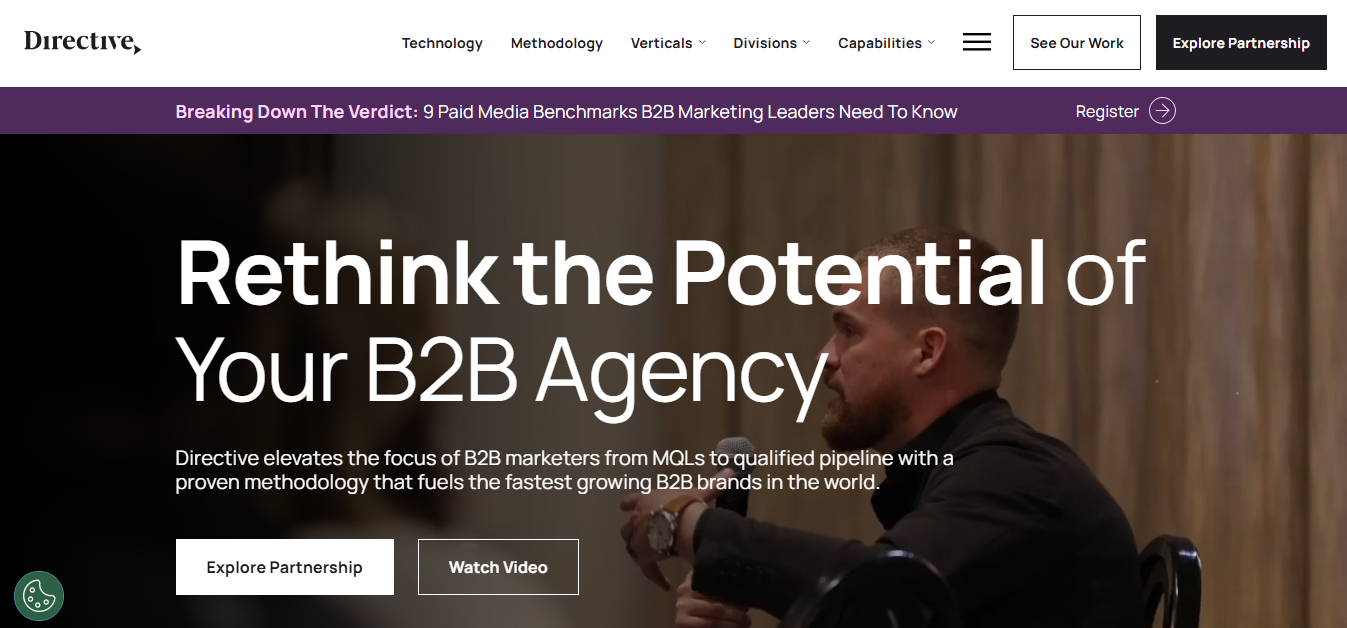
The claim. Directive calls itself a B2B marketing agency, and its PPC page puts lead quality at the center: “Lead quality stays central to every test.” It says offline conversion tracking links PPC campaigns to sales outcomes in your CRM, that it sends qualified lead and opportunity signals back to Google’s Smart Bidding, and that reporting shows cost per opportunity, pipeline impact and CAC by keyword theme.
The proof. Its featured paid media case study is Skillable, where it reports 50% year-over-year pipeline growth and MQL-to-SQL conversion rising from 23% to 42%. Its success stories page lists further named clients across paid media, content and design. It lists offices in Orange County, Austin and New York City, among other cities. On fees, it says agencies usually charge a flat retainer, a percentage of spend or a hybrid, but it publishes no prices or contract length on the page we read. Its six services also include content marketing and revenue operations, so confirm you would be working with the paid media team.
The question. “Which CRM stages do you send back to Google Ads, and how do you handle changes to the way offline conversions are imported?” Google’s documentation says offline imports and enhanced conversions for leads uploads are migrating to the Data Manager API from June 15, 2026, so a current answer shows the setup is maintained.
2. Common Thread Collective: Best for Stores That Grow but Do Not Profit
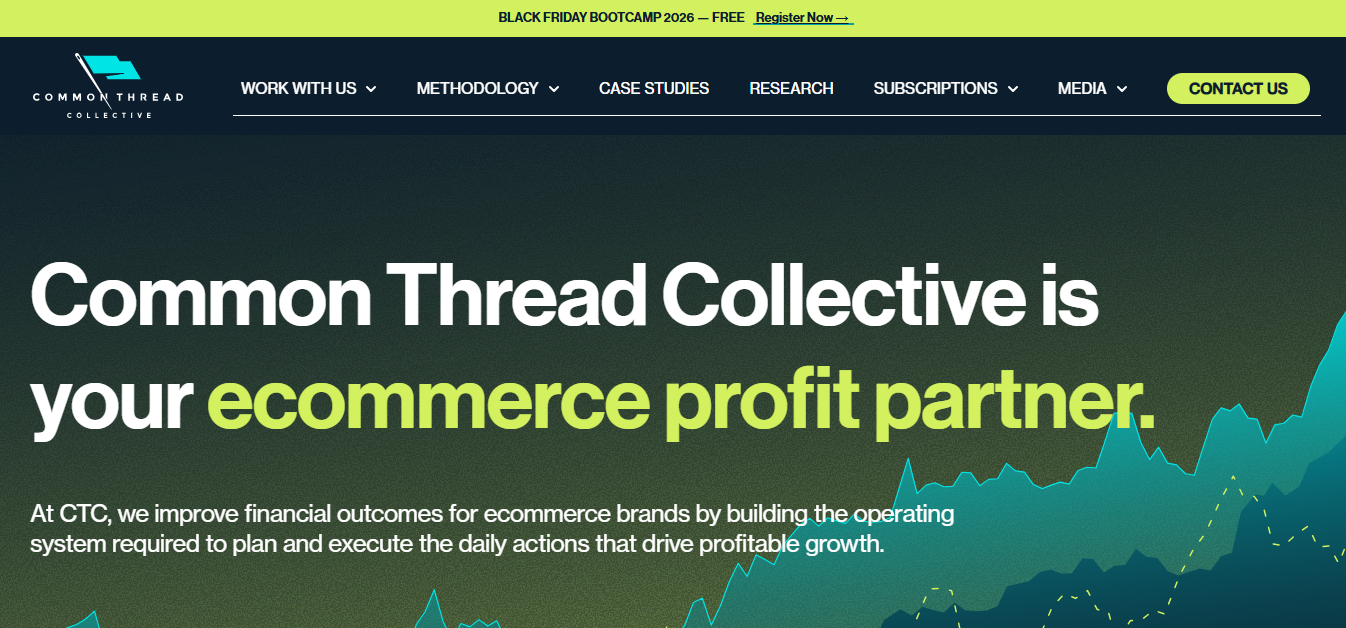
The claim. Common Thread Collective describes itself as an ecommerce growth agency that improves “financial outcomes” for brands, with a focus on contribution margin rather than revenue alone. Its Prophit Engine pairs software with a dedicated “Prophit Engineer” who owns forecasting and execution. Listed services include Google and Meta ad buying, TikTok Shop and incrementality testing.
The proof. Its case studies page names DTC brands with headline results, including UAG (191% increase in purchase conversions through Google Demand Gen), Quay (40% higher ROAS in Q4) and Igloo Coolers (4.6x year-over-year online growth). It lists a Costa Mesa, California address. It publishes no pricing or contract terms. Those headline figures do not explain how results were measured, which is the gap the question below addresses.
The question. “How do you define and measure contribution margin and incrementality for our account, and who owns the forecast?” A specific answer shows the profit focus is a method, not a slogan.
3. Tinuiti: Best for Brands Splitting One Budget Across Channels
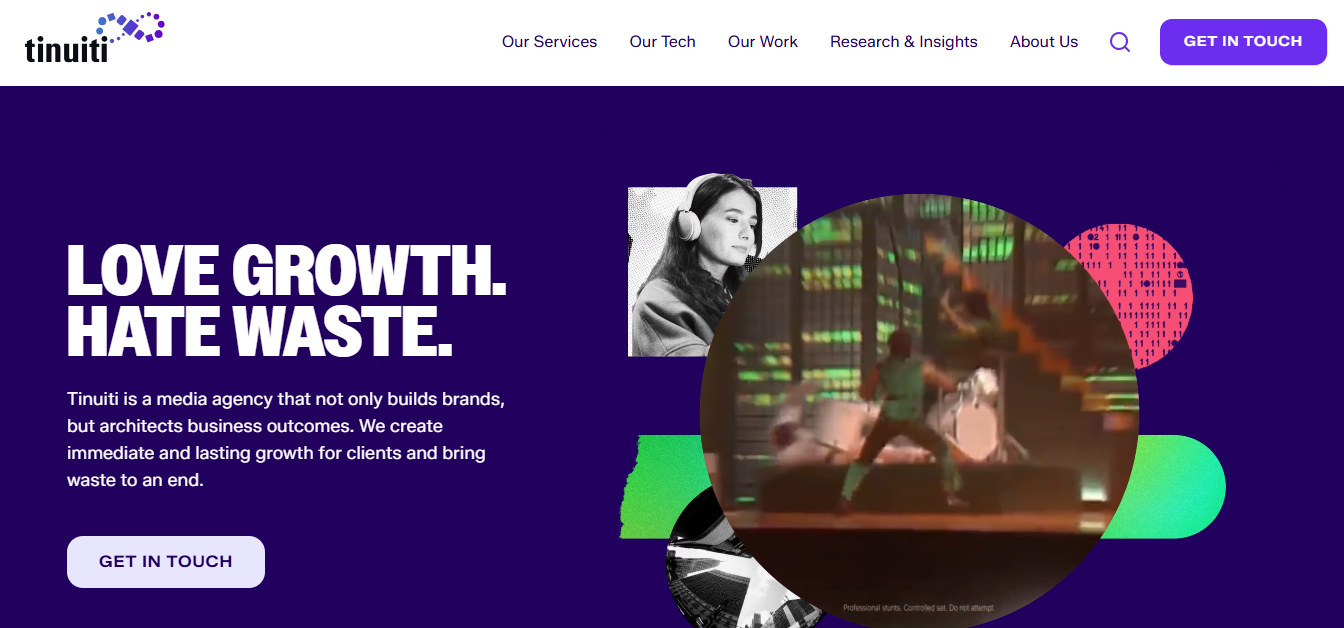
The claim. Tinuiti calls itself the largest independent full-funnel marketing agency and sells a proprietary measurement platform, Bliss Point, whose tools include Incrementality Lab, Media Mix Modeling and Holistic ROAS. It covers paid search, shopping, Amazon, retail media, social, streaming and more, so it suits brands deciding how to split spend between channels, not only how to run search ads.
The proof. Its homepage names case studies including DSW on Meta (16% revenue growth and a 29% lower incremental CPA) and illy on Amazon (15% sales lift in two weeks). Its about page cites $4 billion in digital media under management, more than 1,000 employee owners and a 2022 Google Premier Partner of the Year award in International Growth. It publishes no pricing, and its contact form asks for annual ad spend ranges that start at “Under $1 Million”. It also lists a separate Foundation offering for SMBs and startups.
The question. “Which of our channels would you test for incrementality first, and what budget does that test need?” The answer shows whether its measurement tools fit your spend.
4. Disruptive Advertising: Best for Testing Before You Commit
The claim. Disruptive Advertising is a US agency whose services include paid search, paid social, SEO, CRO, analytics and lead generation. It says it offers a free audit to find wasted ad spend, that it has no long-term contracts, and that “for qualifying brands” it guarantees measurable growth within 90 days or your money back.
The proof. Its homepage shows Google Premier Partner, Microsoft Partner and Meta partner badges, and a Clutch rating of 4.8 from more than 350 reviews, all of which are worth confirming in the directories. It lists target sectors including B2B, SaaS, ecommerce and local, but the page we read showed no named case studies with results, and it publishes no prices. We left out several unsourced statistics on its page.
The question. “What exactly qualifies a brand for the 90-day guarantee, and how is measurable growth defined in writing?” Any guarantee deserves this scrutiny. A conditional one can be fair, but only if the conditions are clear.
5. WebFX: Best for Seeing the Price Before the Sales Call
The claim. WebFX offers PPC for B2B, B2C, SMB, enterprise and ecommerce, and describes a proprietary platform, RevenueCloudFX, built to track marketing activity to revenue. It says it connects to the tools you already use and gives real-time visibility into what to scale and what to cut.
The proof. WebFX publishes PPC pricing by ad spend tier. Lite covers $100 to $5,000 in monthly spend with a $1,200 setup and a $750 management fee. Pro covers $5,000 to $30,000 with a $2,250 setup and a $975 fee, or 15% of spend if higher. Enterprise starts above $30,000 with a $5,800 setup and a $4,500 fee, or 12% of spend if higher. It says clients keep admin or owner access to campaigns in their own ad accounts, and that all tiers include monthly reports and Google Analytics goal tracking. It lists Google Premier Partner and Microsoft Advertising among its badges.
The question. “What are the contract length and cancellation terms, and what is excluded from the management fee?” The pricing page we read gives no contract terms, and add-ons such as landing page testing are priced separately.
How These Five Were Chosen: Five Proof Tests
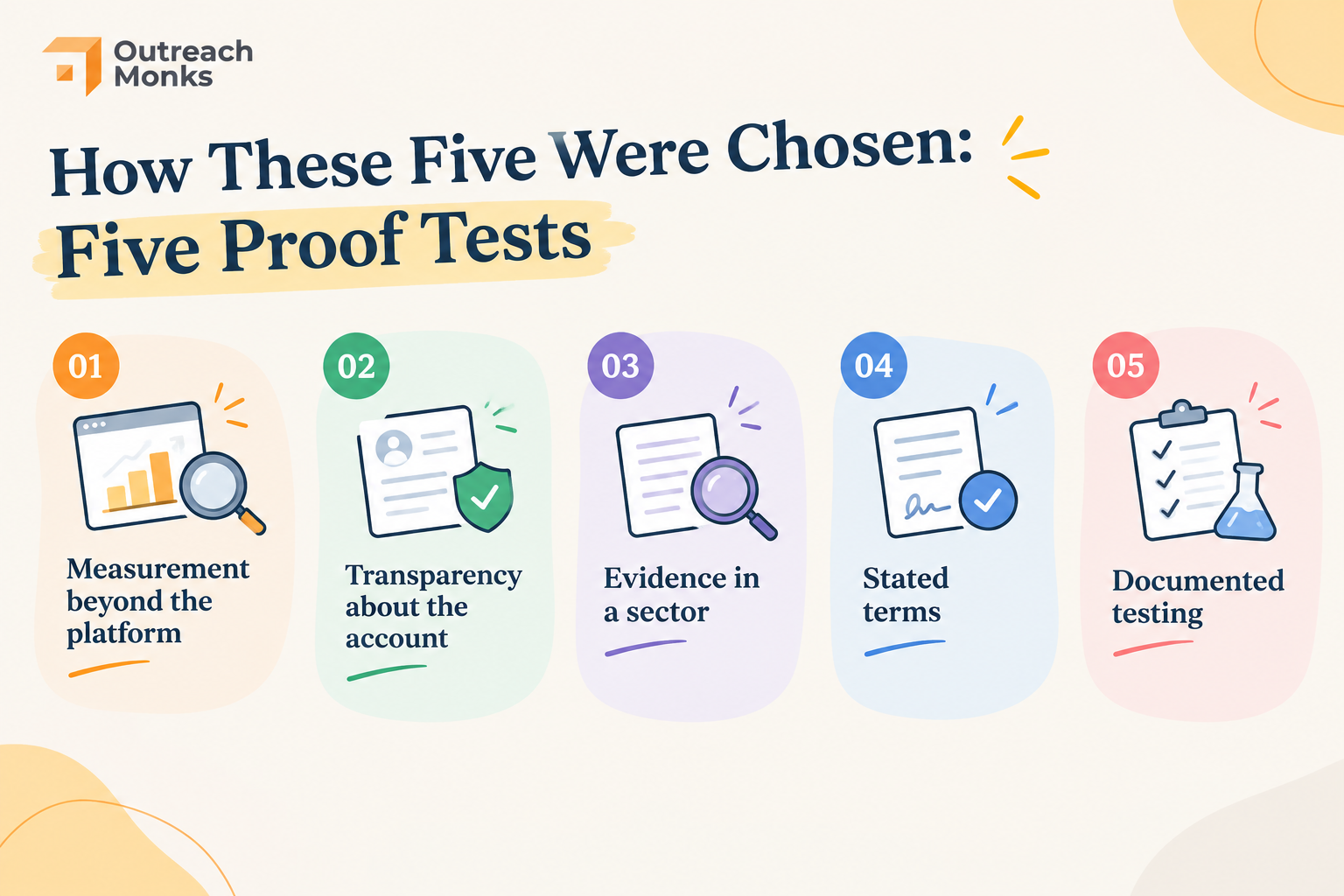
Each test is tied to something you can check on an agency’s own site or in a public directory. We did not rank the agencies, and none of them passes every test publicly. That is deliberate, and it is why the later sections tell you what to ask for directly.
- Measurement beyond the platform. Does it describe tracking tied to CRM, store or finance data, not just the ad platform’s own numbers?
- Transparency about the account. Does it say you keep access to your ad accounts and see search terms and structure?
- Evidence in a sector. Does it show named case studies in a vertical you can compare to your own?
- Stated terms. Does it publish pricing or contract terms, or at least describe fee models?
- Documented testing. Does it explain how it tests, including incrementality, landing pages or experiments?
Also check partner status in Google’s and Microsoft’s own partner directories, not just on the agency’s website. Every case study figure below is the agency’s own claim and has not been independently verified.
The First 90 Days: What Conversion-Focused Onboarding Should Look Like
No agency is bound to this timeline, and it is editorial guidance, not a description of any one agency’s process. It does match advice from Search Engine Land, which recommends asking what to expect at 30, 60 and 90 days and verifying results with a tool such as Google Analytics 4.
- Weeks 1 and 2: tracking and definitions. An audit of what is being measured, an agreed definition of a qualified lead or sale, and a clear list of primary conversion actions. Our guide to GA4 and how it differs from Universal Analytics is useful background for what your new reports should be built on.
- Weeks 3 and 4: structure and waste. Account structure, negative keywords and a first pass at removing spend on searches that cannot convert. Google says Smart Bidding has a standard 7 to 14 day learning phase, so expect restraint, not constant changes.
- Month 2: structured tests. Written hypotheses for ads, landing pages and offers, each with a metric and a stopping point.
- Month 3: reporting tied to revenue or pipeline. The first report that connects spend to qualified leads, customers or margin, reconciled to your own data.
Five Documents to Ask For Before You Sign
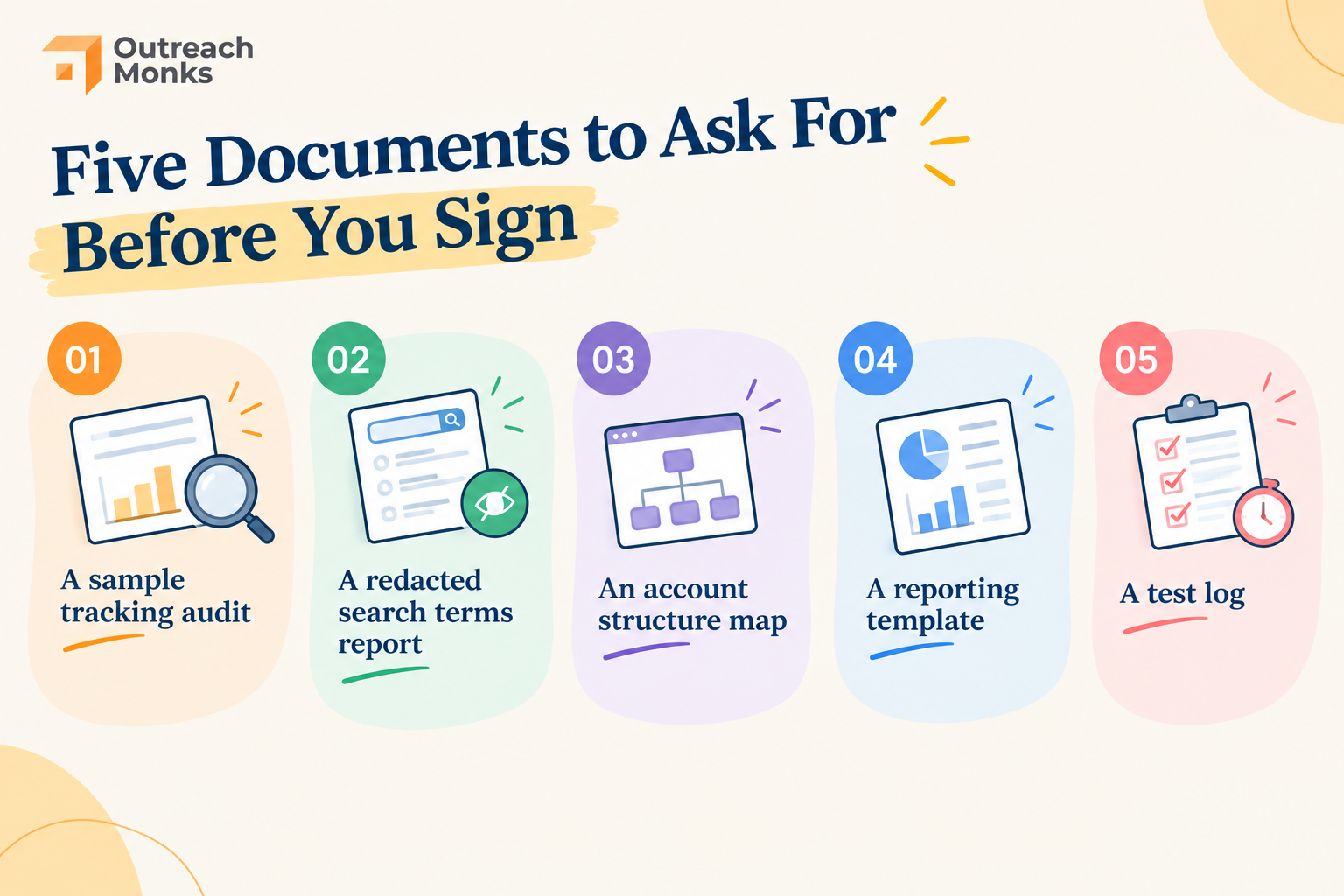
These requests work with any agency, including the five above, and a good agency will not mind them.
- A sample tracking audit. It shows how they check that conversions are recorded correctly.
- A redacted search terms report. It shows what queries they pay for and how they handle waste.
- An account structure map. It shows how campaigns are organized and why.
- A reporting template. It shows whether reports end at clicks or continue to revenue or pipeline.
- A test log. It shows hypotheses, results and what they changed afterwards.
Red flags to watch for.
- Guaranteed results with no written conditions. Search Engine Land puts it plainly: no agency can guarantee specific PPC results. We make the same case for organic search in our piece on the first-page SEO guarantee.
- Limited or no access to your own ad accounts.
- No emphasis on conversion tracking, or reports that stop at clicks.
- A fee structure you cannot explain. Percentage-of-spend fees can reward higher spend, while flat fees need clear deliverables.
Paid and Organic Share the Same Customers
Paid and organic search answer the same questions from the same people, so each can teach the other. Your search terms report shows which queries convert, which is useful input for organic search SEO planning, for checking keyword difficulty and for finding related searches to cover, as People Also Search For results suggest. In return, organic data shows which pages already earn clicks, and our comparison of Google Analytics and Google Search Console explains how to cross-check traffic. Ask your PPC agency to share search term and landing page data with whoever handles organic, and agree on one definition of a conversion.
Outreach Monks does not run paid media and is not on this list. We are a link building and SEO agency. Our SEO packages cover link building, content and keyword research on a month-to-month basis, and we also offer SaaS backlinks and link building for ecommerce. Organic results build slowly while paid results start fast, so a step-by-step SEO roadmap helps you plan the two together.
Pick the Agency That Can Name Your Cost Per Customer
The right PPC agency depends on your situation, and no one of the five is the best for everyone. A B2B team drowning in unqualified leads, a store with growth but thin margins and a brand splitting budget across six channels need different strengths.
Whichever you shortlist, return to the first question and ask for the five documents. An agency that can name your cost per customer, and show you how it knows, is the one focused on conversions.
Frequently Asked Questions
What is a conversion-focused PPC agency?
It is an agency that measures success by outcomes you value, such as qualified leads, sales or profit, instead of clicks and impressions. In practice it sets up conversion tracking carefully, connects ad data to your CRM or store, and reports cost per acquisition and revenue, not just traffic.
How is a conversion-focused agency different from a click-focused one?
A click-focused agency reports activity: impressions, clicks, click-through rate and cost per click. A conversion-focused agency reports results and builds its optimizations around them, including lead quality and revenue. The difference shows in the report: does it end at the click, or continue to the customer?
Which PPC metrics should an agency report to me?
At minimum: spend, conversions defined as primary actions, cost per acquisition or qualified lead, conversion rate, and revenue or ROAS reconciled to your own data. For lead generation, add sales accepted leads and opportunities. Clicks and impressions are useful context, but they should never be the headline.
How do PPC agencies charge, and what should I watch for in the fee structure?
Common models are a percentage of ad spend, a flat retainer, performance-based fees or a hybrid. Search Engine Land notes percentage fees are typically 10% to 20% of spend and can reward higher spending, while flat fees need clear deliverables. Ask about setup fees, add-ons and contract length.
How long before PPC conversions improve?
Paid campaigns can produce data quickly, but improvement takes time because tracking must be correct and bidding needs data to learn. Google describes a standard learning phase of 7 to 14 days for Smart Bidding. Expect meaningful conversion trends over a few months, and treat any promised timeline with caution.
Should PPC and SEO be run together?
They do not have to share an agency, but they should share data. Search terms that convert in paid can guide organic targets, and organic strength can reduce reliance on paid over time. Our guide to on-page and off-page SEO explains what the organic side involves so the two plans can be coordinated.

