
Ecommerce SEO is not regular SEO with products bolted on. A blog has a few hundred pages that barely change. A store has thousands that change constantly – stock comes and goes, variants multiply, filters spin up near-duplicate URLs by the thousand, and seasonal lines appear and vanish. Get the architecture wrong and Google spends its crawl budget wading through colour-and-size permutations while your actual money pages sit unnoticed.
That is why hiring a generalist for an ecommerce site so often disappoints. They will fix your title tags and write some blogs. They will not necessarily know what to do with faceted navigation, product variant duplication, orphaned category pages, or 4,000 discontinued SKUs returning soft 404s.
So this list is built around one question: who actually understands stores? We weighed ecommerce specialisation over general reputation, platform depth over service-page buzzwords, technical capability at scale, honest pricing, and verifiable results. Five agencies made it – one offering managed end-to-end SEO with authority building as its standout strength, one for large-catalogue full service, one for DTC brands, one for technical cleanup and migrations, and one for content-led growth.
Quick Answer: The 5 Best Ecommerce SEO Agencies in 2026
If you only read one section, read this one.
- Outreach Monks – Best for managed end-to-end ecommerce SEO. Technical fixes, content, keyword research and AI search visibility, with best-in-class link building – all on published, fixed-deliverable pricing.
- OuterBox – Best for large catalogues and full-service ecommerce. Twenty years in, 300+ staff, deep multi-platform experience.
- NOVOS – Best for DTC and Shopify brands. A UK agency that does ecommerce SEO and nothing else.
- Inflow – Best for technical SEO and site migrations. The team you call when something is structurally broken.
- Siege Media – Best for content-led growth and AI search visibility. Content and digital PR at scale.
No agency can guarantee rankings, and anyone who does is telling you something useful about themselves. Match the agency to your actual bottleneck – authority, technical debt, content, or platform migration – and you will get far more from the engagement.
How We Picked These Agencies
Rankings mean nothing without a method, so here is ours. Each agency was scored against five weighted criteria:
- Ecommerce specialisation (30%). Does ecommerce make up the core of the business, or is it one vertical among twelve? Specialists have seen your problem before.
- Platform and technical depth (25%). Demonstrated capability on Shopify, WooCommerce, Magento, BigCommerce or headless builds – plus the technical chops to handle faceted navigation, variants and migrations.
- Proof of results (20%). Published case studies with real numbers, named clients, and outcomes that can be sanity-checked rather than asserted.
- Pricing transparency (15%). Whether you can find out what something costs without three sales calls. Most agencies fail this; the ones that do not deserve credit.
- Reporting and accountability (10%). Clear deliverables, visible tracking, and a named point of contact who answers email.
This is desk research – public pricing pages, case studies, platform documentation and review profiles – not a paid engagement with all five. Treat it as a well-informed shortlist to vet, not a substitute for your own due diligence. Figures change constantly; verify before you sign.
What to Look for in an Ecommerce SEO Agency
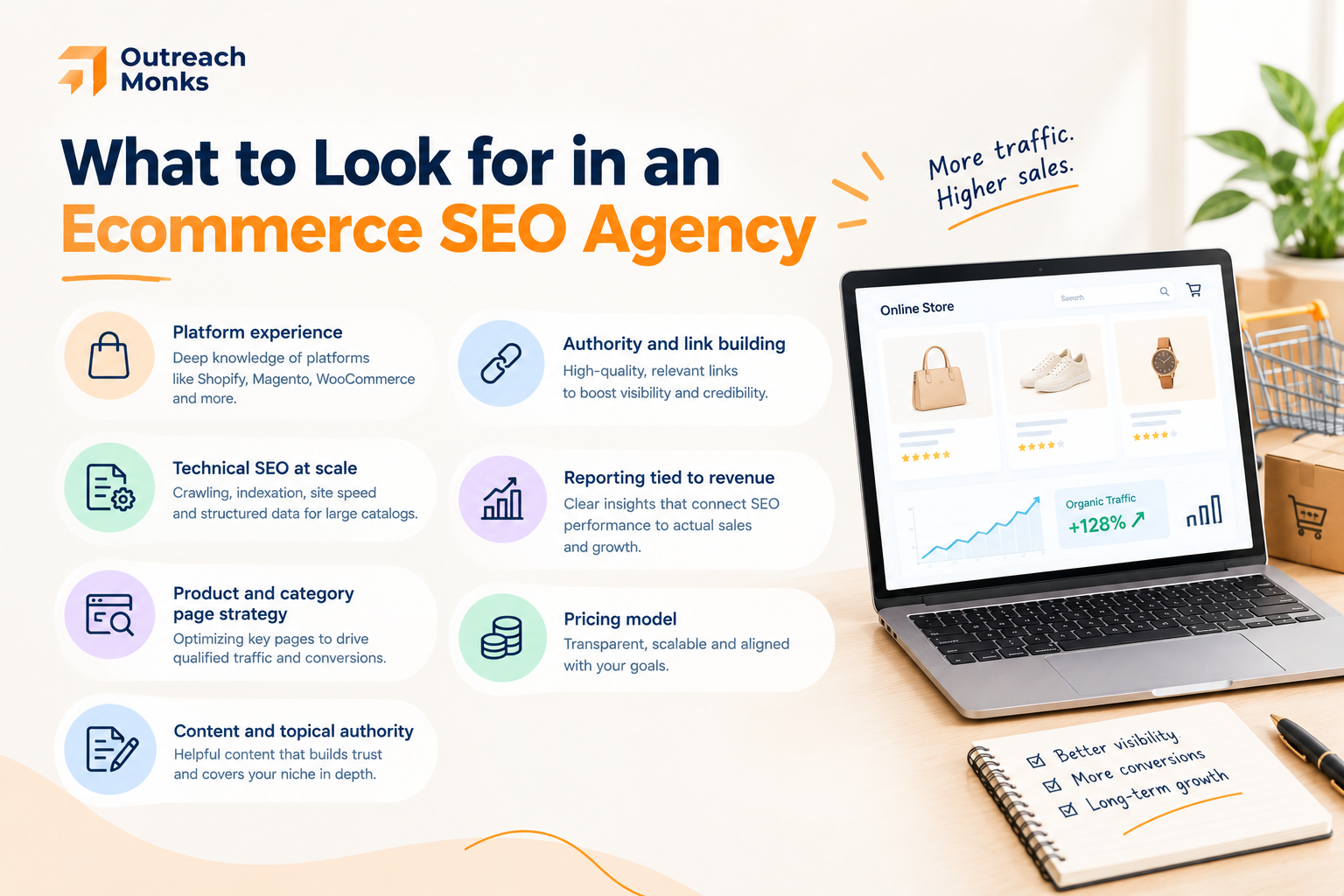
Before comparing names, get clear on what actually matters. These seven criteria separate agencies that move revenue from agencies that move rankings on page-two keywords nobody buys from.
1. Platform experience : Shopify, WooCommerce, Magento and BigCommerce each break differently. Shopify forces a rigid URL structure and limits server-side control. WooCommerce SEO gives you freedom and enough rope to hang yourself with. Magento scales but punishes bad configuration. Ask which platform they have shipped the most work on – not which logos sit on their website.
2. Technical SEO at scale : Faceted navigation, pagination, canonical strategy and crawl efficiency are where ecommerce SEO is won or lost. A 50,000-URL store has problems a 50-page site simply never encounters. Ask how they decide which filter combinations get indexed.
3. Product and category page strategy : Category pages are usually the highest-commercial-intent pages on the site and usually the most neglected. Thin manufacturer descriptions, no unique copy, no internal linking logic. A good agency has an opinion about this before you ask.
4. Content and topical authority : Stores need to rank for commercial queries and the informational ones that feed them. That means a topical map connecting buying guides, comparisons and product pages into clusters – not a blog that posts twice a month about nothing.
5. Authority and link building : Ecommerce is one of the hardest verticals to earn links in, because nobody naturally links to a product page. That makes deliberate, relevance-first ecommerce link building a genuine differentiator – and it is the single capability most full-service agencies quietly outsource.
6. Reporting tied to revenue : Rankings are a proxy. Revenue, assisted conversions and organic share of category are the point. If the monthly report leads with “keywords in top 10” and never mentions money, that tells you what they optimise for.
7. Pricing model : Retainers suit ongoing growth, projects suit defined cleanups, and performance deals usually hide something in the fine print. Whichever model, you should know what you get each month before you pay for it.
Quick Comparison: Top 5 Ecommerce SEO Agencies
Here is how the five stack up side by side before we break down each one in detail.
| Agency | Best For | Core Strength | Platforms | Indicative Pricing |
|---|---|---|---|---|
| Outreach Monks | Managed end-to-end SEO | Full SEO programme with standout link building | Platform-agnostic (all stores) | From $799/mo (published) |
| OuterBox | Large catalogues, full service | Twenty years of ecommerce SEO, PPC and CRO | Shopify, Magento, BigCommerce, WooCommerce | Custom quote |
| NOVOS | DTC & Shopify brands | Ecommerce-only focus with digital PR built in | Shopify-led, plus migrations | Custom quote |
| Inflow | Technical SEO & migrations | Technical audits, migrations, measurement | Shopify, Magento, BigCommerce, custom | Custom quote |
| Siege Media | Content-led growth & AI search | Content production and digital PR at scale | Platform-agnostic | Custom quote |
Pricing note: Outreach Monks publishes package pricing openly, with fixed deliverables per tier. The other four quote custom, which is standard in this market – most ecommerce SEO retainers land somewhere between $2,500 and $10,000+ per month depending on catalogue size and scope. Always confirm current figures and what is actually included before signing.
The 5 Best Ecommerce SEO Agencies in 2026
1. Outreach Monks – Best for Managed End-to-End Ecommerce SEO
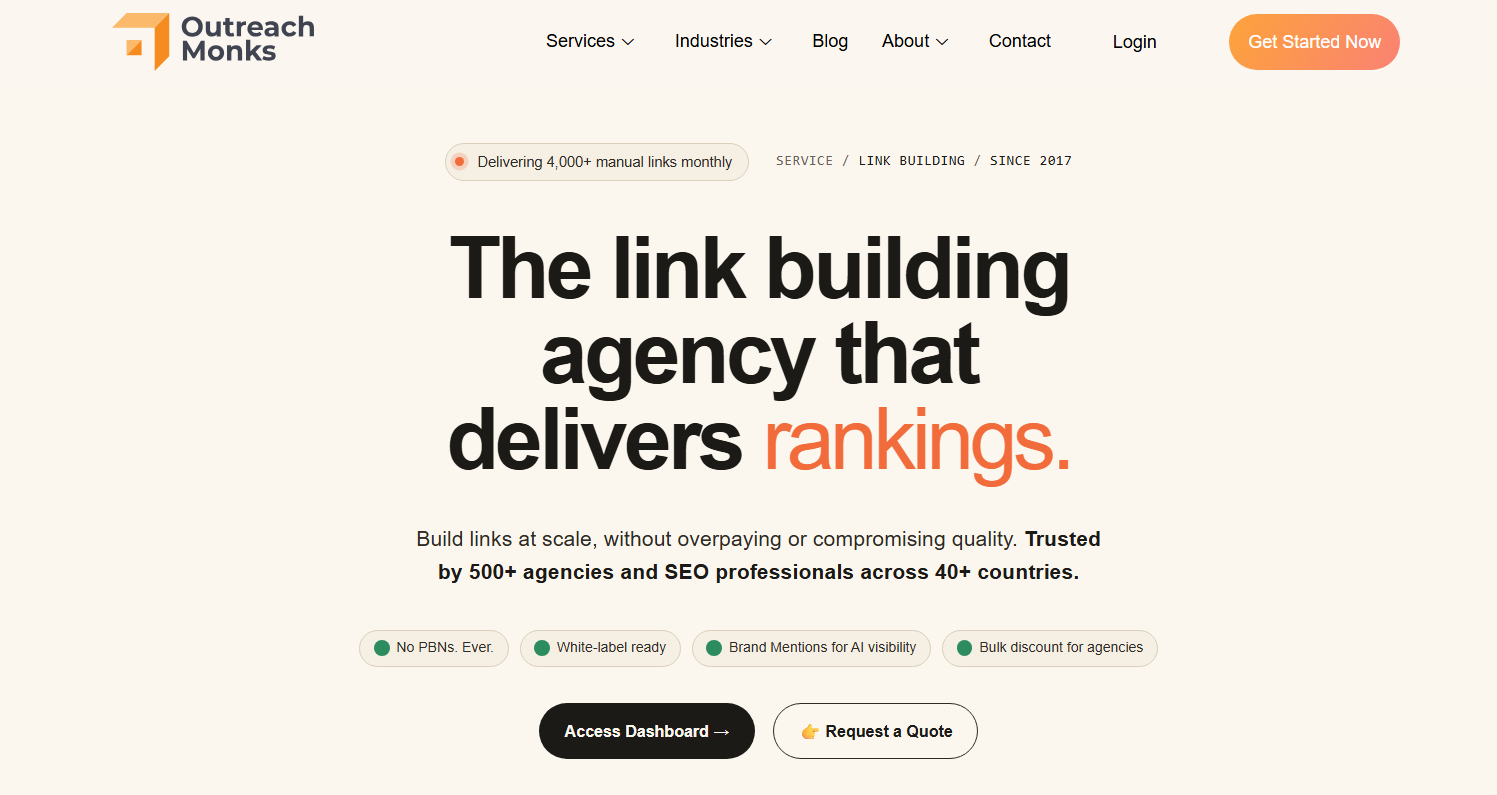
Most agencies make you choose between a technical shop that treats links as an afterthought and a link vendor that will not touch your site. Outreach Monks runs the whole programme under one team, covering technical and on-page fixes, keyword research, content, internal linking and AI search visibility.
What puts them at the top of this list is that the hardest part of ecommerce SEO, earning genuine authority, is the thing they are best known for rather than the thing they quietly outsource. On that side the work is 100% manual outreach to real, traffic-carrying sites, split across guest posting, niche edits and digital PR for brand mentions. No PBNs, no automation.
What sets them apart commercially is transparency. Their SEO packages are built on fixed monthly deliverables, meaning a set number of keywords, page fixes, blog posts and links, all spelled out before you sign. Pricing is published rather than hidden behind a discovery call, billing is month to month with no long contract, and links carry a six-month replacement guarantee.
Their ecommerce case studies include a fashion brand taken from 70K to 419K monthly visitors and a DTC label grown from zero to 99K in ten months without paid ads. They also work restricted verticals such as cannabis, vape and supplements that most agencies decline outright.
Strengths:
- Full-service programme – technical fixes, content, keyword research and links from one team
- Published, fixed-deliverable pricing from $799/month, with month-to-month billing and no lock-in
- Best-in-class link building: 100% manual outreach, enforced niche relevance, no PBNs
- AI search visibility optimisation included on every tier at no extra cost
- Live dashboard tracking, six-month link replacement guarantee, and white-label delivery for agency partners
- Comfortable in restricted niches most agencies turn away
Watch-outs:
As with any SEO programme, the level of results can vary based on factors such as competition, website condition, industry, and the scope of work. Brands with more specific requirements can discuss their goals with the team and align the package, content, technical work and link-building strategy accordingly.
Pricing (indicative): Published managed SEO packages from $799/month (Starter) through $1,599 (Growth), $2,999 (Pro) and $4,999 (Authority), each with a one-time setup fee. Standalone link building packages run from $999/month for stores that only need the authority piece. Custom scopes available.
Best for: Ecommerce brands that want one accountable team running the full SEO programme with genuinely strong link building attached – and anyone tired of agencies that will not tell them the price before a sales call.
2. OuterBox – Best for Large Catalogues and Full-Service Ecommerce
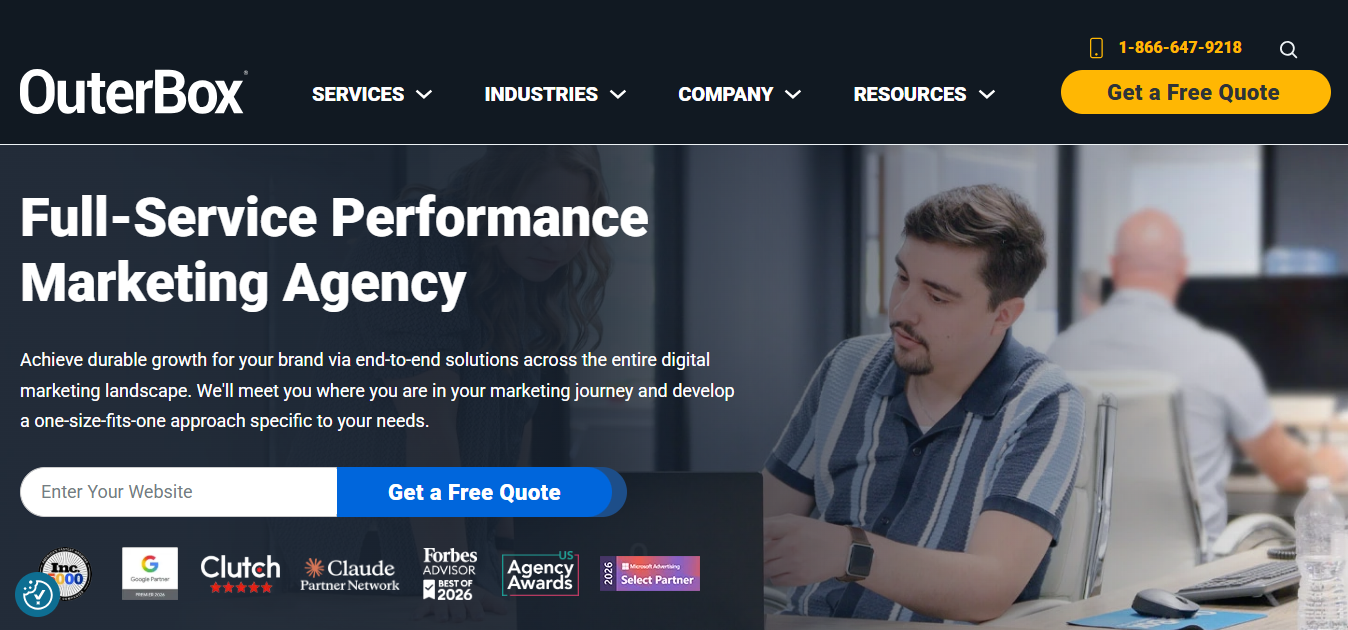
Twenty years is a long time to do anything, and OuterBox has been doing ecommerce since 2004 – long enough to have seen every algorithm update, platform migration and replatforming disaster the industry has produced. With 300+ staff across Akron, Houston and Tuscaloosa, they are among the largest dedicated ecommerce shops in the US.
The appeal is breadth under one roof. SEO sits alongside PPC, CRO, web design and development, which matters when a technical fix needs a developer and a landing page needs a designer and you would rather not project-manage three vendors. Their client list skews toward large, complex catalogues – JEGS, Corsa Performance, Golfballs.com, Rocky Boots, Sur La Table – the kind of sites with tens of thousands of SKUs where crawl efficiency and category architecture genuinely decide outcomes.
Strengths:
- Two decades of ecommerce-specific experience and 1,000+ client engagements
- Genuine multi-platform depth: Shopify, Magento, BigCommerce and WooCommerce
- SEO, PPC, CRO, design and development in one team – fewer vendor handoffs
- Proven on large, complex catalogues rather than boutique stores
Watch-outs:
Scale cuts both ways. A 300-person agency has process and redundancy, but a small store can end up a small account – ask directly who will run your day-to-day and how often you will speak. Pricing is not published, and a full-service engagement is unlikely to suit a store doing modest monthly revenue.
Pricing (indicative): Custom quote; not publicly listed. Expect mid-to-upper market retainers consistent with full-service scope.
Best for: Mid-market and enterprise retailers with large catalogues who want SEO, paid and conversion work handled by a single accountable team.
3. NOVOS – Best for DTC and Shopify Brands
Plenty of agencies list ecommerce as a specialism. NOVOS does ecommerce and only ecommerce, and that focus shows in how they talk about the work. The London-based, employee-owned team has built its reputation on fast-growing consumer brands – Ruggable, Osprey, TALA, MORI, Pooch & Mutt, Vitabiotics – where the challenge is less enterprise crawl management and more carving out visibility in crowded, competitive DTC categories.
Their approach pairs technical and content SEO with digital PR, which is the right instinct for DTC. Consumer brands earn links through stories and products people care about, not through resource pages. They have also leaned early into AI search optimisation, framing the goal as being the answer when a customer asks a question anywhere – a sensible read of where ecommerce discovery is heading as more journeys start in an AI assistant and end in a zero-click result.
Strengths:
- Pure ecommerce focus – no SaaS or B2B divisions competing for attention
- Strong DTC and Shopify track record with named, recognisable consumer brands
- Digital PR integrated with SEO rather than sold as a separate line item
- Employee-owned structure, which tends to correlate with lower staff churn on accounts
Watch-outs:
UK-based, so US brands should confirm time-zone overlap and whether the team has depth in American SERPs for your category. Their sweet spot is consumer and lifestyle brands; a 100,000-SKU industrial parts catalogue is a different sport. Pricing is quote-only.
Pricing (indicative): Custom quote; not publicly listed.
Best for: DTC and consumer brands – particularly on Shopify – that want ecommerce specialists and need digital PR as part of the growth plan.
4. Inflow – Best for Technical SEO and Site Migrations
Some engagements are not about growth at all. They are about stopping the bleeding – a migration that tanked traffic, an index full of parameter URLs, a replatform scheduled for next quarter that nobody wants to get wrong. Inflow is the team built for those jobs.
Operating from Denver and Tampa since 2007, they combine technical audits, migration planning and measurement work with the analytics rigour that makes the results legible. GA4 and Google Tag Manager audits are a named service, which sounds unglamorous until you realise how many stores are making decisions on broken conversion tracking. They hold Google Premier Partner, Microsoft Ads Partner and Meta Business Partner status, and their ecommerce case studies – KEH Camera, Vitrazza, Simms Fishing, Mountain House – are mid-market stores rather than vanity enterprise logos.
Strengths:
- Deep technical audit and site migration capability – the highest-risk work in ecommerce SEO
- Analytics and tracking audits included, so performance data can actually be trusted
- Nearly two decades operating, with recognised platform partner credentials
- Mid-market focus with relevant, verifiable ecommerce case studies
Watch-outs:
Inflow spans several industries – healthcare and travel alongside ecommerce – so confirm your account team is staffed with store-side experience, not just reassigned from another vertical. Their strength is technical and measurement work; if your bottleneck is purely authority, that still needs solving elsewhere.
Pricing (indicative): Custom quote; not publicly listed.
Best for: Mid-market stores facing a migration, recovering from a traffic drop, or carrying technical debt that is capping everything else.
5. Siege Media – Best for Content-Led Growth and AI Search Visibility
If your category is won on content rather than product pages – buying guides, comparisons, the research people do before they ever reach a store – Siege Media is the strongest option here. They produce content and earn links at a volume most agencies cannot match, with offices in Austin, New York, Chicago and San Francisco and clients including Zendesk, Instacart, Zapier, Airbnb and Asana.
They have also repositioned hard around generative engine optimisation, aiming at visibility inside AI-generated answers rather than blue links alone. For ecommerce that is a real consideration: a shopper asking an AI assistant for the best option in a category is being served from sources the model trusts. Being one of those sources is a content and citation problem, which happens to be exactly what Siege does. Treat the AI angle as a sensible bet rather than a guarantee – nobody can promise an AI citation.
Strengths:
- Content production and digital PR at genuine scale, with enterprise-grade clients
- Early, serious investment in GEO and AI search visibility
- Strong at top-of-funnel demand capture that feeds commercial pages
- Multiple US offices and established research and data-study capability
Watch-outs:
Ecommerce is one of eight verticals they serve, not the whole business – so they are less of an ecommerce specialist than NOVOS or OuterBox. They are also not the choice for technical store problems; a crawl-budget crisis needs a different team. Enterprise positioning means enterprise budgets.
Pricing (indicative): Custom quote; not publicly listed. Positioned at the enterprise end of the market.
Best for: Established brands with budget whose growth depends on winning informational search and AI-answer visibility, not fixing technical debt.
Ecommerce SEO Agency vs. Generalist SEO Agency
This is the distinction that decides whether your budget works. Both will audit your site and talk about keywords. Only one has seen what happens when a filter system generates 80,000 crawlable URLs overnight.
| Area | An ecommerce specialist handles | A generalist often misses |
|---|---|---|
| Faceted navigation | Decides which filter combinations are indexable, which are canonicalised, and which are blocked outright | Lets filters generate thousands of near-duplicate indexable URLs |
| Product variants | Sets a deliberate canonical and indexation strategy across sizes, colours and configurations | Treats each variant as a standalone page, creating duplication at scale |
| Category pages | Treats them as primary commercial landing pages with unique copy and internal linking | Optimises blog posts and leaves category pages on default template text |
| Out-of-stock & discontinued | Plans status codes, redirects and internal links around product lifecycle | Leaves soft 404s and dead internal links accumulating |
| Crawl efficiency | Manages crawl paths so key pages are found and refreshed on large catalogues | Assumes a sitemap is enough |
| Seasonal & inventory SEO | Builds evergreen seasonal URLs rather than deleting and rebuilding each year | Rebuilds pages annually and loses accumulated equity |
| Link building | Earns links to category and guide pages that can pass equity to products | Builds links only to the homepage and a blog |
Worth understanding too: much of this is on-page and technical work versus off-page authority – two different disciplines that often need two different kinds of partner. Very few agencies are genuinely excellent at both, which is why the hybrid model below is so common.
What Ecommerce SEO Actually Costs in 2026
Almost nobody publishes pricing, which makes budgeting guesswork. Here is a realistic picture of the market so you can tell a fair quote from an optimistic one.
- Small stores and startups ($1,000–$3,000/month). Typically a focused scope – technical fixes, core category optimisation, or a standalone link building programme. Not full service, and that is fine; focus beats thin coverage at this budget.
- Mid-market ($3,000–$8,000/month). The most common band for a genuine ongoing programme: technical, content, authority and reporting together, with a named account team.
- Enterprise ($8,000–$25,000+/month). Large catalogues, multiple markets or languages, in-house teams to coordinate with, and senior strategic input.
- Project work ($3,000–$30,000 one-off). Migrations, deep technical audits and replatform support are often better bought as defined projects than folded into a retainer.
Two things to watch. First, a low retainer that covers “SEO” with no itemised deliverables usually means a few hours of generic work. Second, ask what proportion of the fee goes to actual placements versus management when buying authority – with transparent link building pricing you can do that arithmetic yourself.
Realistic Timelines: What Happens, and When
“SEO takes six months” is the industry’s laziest answer. Different work pays off on genuinely different schedules, and knowing which is which keeps you from panicking in month two or coasting in month five.
| Type of work | First signals | Meaningful impact |
|---|---|---|
| Technical fixes (crawl, indexation, status codes) | 2–6 weeks as pages are recrawled | 1–3 months; often the fastest visible win |
| Category & product page optimisation | 4–8 weeks | 2–4 months, depending on competition |
| New content & topical clusters | 6–12 weeks per cluster | 4–8 months as the cluster matures |
| Link building & authority | 2–3 months as links are indexed | 6–12 months; compounds rather than spikes |
| Site migration | Immediate – and often negative at first | 1–3 months to recover and exceed baseline |
If an agency promises transformational revenue in 60 days, they are either planning to count branded traffic as a win or they are not being straight with you. Equally, if month six arrives with nothing moving on any of the above, that is a legitimate conversation to have.
How to Verify an Agency’s Case Studies
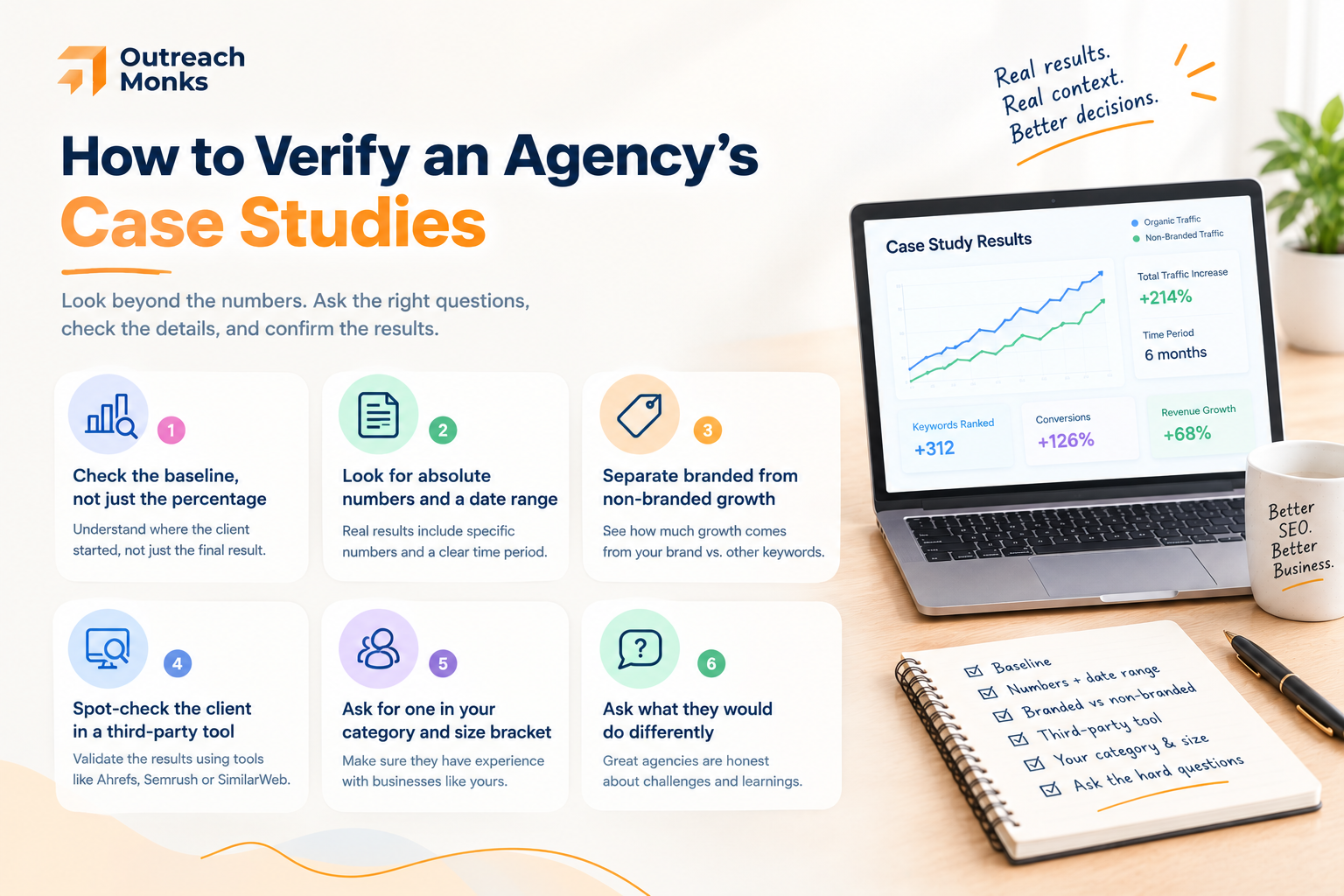
Every agency shows case studies. Almost nobody tells you how to check them, so here is the short version – five minutes of this will tell you more than an hour on a sales call.
- Check the baseline, not just the percentage. “+400% organic traffic” from 200 visitors a month is 1,000 visitors. Impressive-sounding growth from a near-zero starting point is close to meaningless for an established store.
- Look for absolute numbers and a date range. Real results come with both. A percentage with no timeframe and no starting figure is marketing, not evidence.
- Separate branded from non-branded growth. If the brand ran a major campaign or got press during the engagement, branded search rises on its own. Ask specifically what happened to non-branded organic revenue.
- Spot-check the client in a third-party tool. Pull the domain into any rank tracker or traffic estimator and see whether the trend line roughly matches the claim and the timeframe. Estimates are imperfect, but a flat line against a 500% claim is a flag.
- Ask for one in your category and size bracket. Enterprise results do not transfer to a 300-SKU store, and fashion does not transfer to industrial parts. Relevance beats magnitude.
- Ask what they would do differently. Anyone who has actually run the engagement has an answer. A polished non-answer suggests the case study was written by marketing, not by the delivery team.
Contracts, Reporting and What You Own When You Leave
Almost every roundup skips the exit, which is strange – because what you keep when an engagement ends is a large part of what you actually bought.
Minimum terms. Six to twelve months is standard and often reasonable, since meaningful work takes time. What is not reasonable is a long lock-in with no performance review point and no exit clause. Ask what happens at month three if it is not working.
Reporting cadence and substance. Monthly is normal; what matters is content. You want work completed, what changed as a result, and what is planned next – tied to revenue and non-branded organic, not just a ranking screenshot. Live dashboards beat PDFs you receive three weeks after month end.
Asset ownership. Confirm in writing that you own the content produced, the accounts and properties created, and the documentation. Agencies occasionally build in their own tooling or accounts, which gets awkward at handover.
What happens to your links. Editorial links placed on genuine third-party sites stay live after you leave – that is one of the real advantages of earned placements over rented ones. Anything paid for on a recurring basis disappears when payment stops, which is worth knowing before you build a strategy on it. Expect some natural link decay over time either way, and ask whether replacement is covered.
Offboarding. A professional handover includes a documented summary of work completed, outstanding recommendations, and admin access transferred cleanly. Ask what their offboarding process looks like – the answer is revealing.
How to Choose the Right Agency for Your Store
By store size
- Small DTC (under ~500 SKUs): Prioritise focus over breadth. A specialist solving one real bottleneck beats a thin full-service retainer. Authority is often the binding constraint once the basics are done.
- Mid-market (500–10,000 SKUs): This is where technical architecture starts to bite and a genuine ongoing programme pays for itself. Inflow and NOVOS sit naturally here.
- Enterprise (10,000+ SKUs): Crawl efficiency, internationalisation and coordination with in-house teams dominate. OuterBox and Siege Media operate at this scale.
By platform
- Shopify: You trade control for stability. Look for agencies fluent in working within Shopify’s URL and template constraints – NOVOS and OuterBox both qualify.
- WooCommerce: Maximum flexibility, maximum opportunity to misconfigure. Technical depth matters more here than anywhere else.
- Magento / Adobe Commerce: Powerful and unforgiving at scale. Demand specific Magento case studies, not general ecommerce ones.
- Headless or custom: Rendering and crawlability become the central question. Ask directly how they audit JavaScript-rendered content.
By primary goal
- Organic revenue growth: A full-service partner with genuine content and authority capability under one roof, or a technical agency paired with a dedicated authority partner.
- Technical cleanup or migration: A technical specialist on a defined project. Do not buy a twelve-month retainer for a three-month problem.
- Authority and competitive gap: A link building specialist. This is the one capability most reliably bought separately and well.
- New market expansion: Confirm genuine experience in the target market’s SERPs and language, not just a translation workflow.
The hybrid model most growing stores land on
Here is something no competing roundup will tell you: on-site SEO and off-site authority are genuinely different disciplines. Technical SEO is closer to engineering; outreach is relationship-driven media work. Most agencies are strong at one and quietly subcontract the other – which is why so many of them rely on SEO reseller and white-label partners behind the scenes, with a margin added on top.
That leaves you two sensible routes. Either split the work deliberately – a technical or content partner on-site, a specialist authority partner off-site – so you get clear accountability for each half. Or pick a single provider that genuinely does both in-house and will show you the deliverables for each, rather than bundling everything into one opaque retainer. Outreach Monks is the example on this list of the second route; pairing Inflow or OuterBox with a dedicated authority partner is the first. What you want to avoid is the middle case: one agency charging for both and outsourcing half of it without telling you.
Questions to Ask Before You Hire
Take these into the first call. The answers – and how quickly they come – will separate the shortlist fast.
- Can you show me an ecommerce case study in my category and roughly my catalogue size, with starting numbers and dates?
- How do you decide which faceted navigation URLs get indexed, canonicalised, or blocked?
- What is your approach to product variants and duplicate content at scale?
- Who exactly will work on my account day to day, and what is their ecommerce experience?
- How do you build links for ecommerce, and do you do it in-house or outsource it?
- What does the monthly report contain, and does it tie to revenue or just rankings?
- What is the minimum term, and what happens if performance is flat at month four?
A good agency welcomes these. Hesitation on question five in particular is worth noticing – it is the one most often answered vaguely because the work is being passed to someone else.
Red Flags and Common Hiring Mistakes
Red flags:
- Guaranteed rankings or guaranteed first-page placement. Nobody controls Google’s results – here is why a first-page SEO guarantee should worry rather than reassure you.
- Vague link building answers, cheap bulk packages, or anything that sounds like a private network. Understanding natural versus unnatural backlinks is the cheapest insurance you can buy against a penalty.
- No ecommerce-specific case studies – only lead-gen or local business examples
- Reporting built entirely around keyword rankings, with no revenue or conversion context
- No named point of contact, or a different person on every call
- Pressure to sign long contracts immediately, with no performance checkpoint
Common mistakes:
- Choosing on price alone. The cheapest retainer is usually the most expensive way to lose six months.
- Hiring a generalist because they came recommended by a non-ecommerce business.
- Buying authority before fixing technical problems – links to a broken site do not help.
- Expecting results on a timeline the work does not support, then switching agencies before anything compounds.
- Ignoring the basics that convert the traffic you do earn. Rankings are wasted if the store does not build trust with visitors.
Conclusion
There is no universally best ecommerce SEO agency – only the right fit for your catalogue, your platform and the specific thing currently holding you back. Diagnose that first, and the shortlist writes itself.
Want one team running the full programme with serious authority building attached? Outreach Monks. Running a large catalogue and need SEO, PPC and CRO together? OuterBox. Building a DTC brand on Shopify? NOVOS. Facing a migration or technical debt? Inflow. Winning your category on content and AI visibility? Siege Media.
Whichever route you take, remember what an agency can and cannot do. They can fix architecture, sharpen your category pages, produce content and earn you placements. They cannot manufacture demand for a product nobody wants, and they cannot promise rankings. The stores that win are the ones that get the technical foundations right and build genuine authority on top of them patiently – ideally with both halves handled by a team that will show you exactly what it is delivering each month, whether that is a managed SEO package or focused ecommerce link building alongside your existing setup.
Frequently Asked Questions
What is an ecommerce SEO agency?
An ecommerce SEO agency specialises in improving organic search visibility for online stores. Beyond standard SEO, that means handling product and category page optimisation, faceted navigation and filter indexing, product schema, variant duplication, crawl efficiency on large catalogues, and the product lifecycle issues – out-of-stock and discontinued items – that stores face and content sites never do.
How much does ecommerce SEO cost in 2026?
Most ongoing ecommerce SEO retainers fall between $2,500 and $10,000 per month. Smaller stores with a focused scope can start around $1,000–$3,000, mid-market programmes typically run $3,000–$8,000, and enterprise work with large catalogues or multiple markets commonly exceeds $8,000. One-off projects like migrations or deep technical audits are usually quoted separately at $3,000–$30,000.
What is the difference between ecommerce SEO and regular SEO?
Scale and page type. Regular SEO usually optimises a manageable set of fairly stable pages. Ecommerce SEO manages thousands of pages that change constantly, where filters can generate near-duplicate URLs automatically, products appear and disappear with stock, and the highest-value pages are category and product templates rather than articles. The fundamentals are the same; the failure modes are completely different.
How long does ecommerce SEO take to show results?
It depends on the work. Technical fixes often show movement within two to six weeks as pages are recrawled. Category and product optimisation typically takes two to four months. New content clusters mature over four to eight months, and link building compounds over six to twelve. Expect early signals in the first quarter and meaningful revenue impact from months four to nine for most stores.
Which ecommerce SEO agency is best for Shopify stores?
For DTC and consumer brands on Shopify, NOVOS is the strongest pure specialist thanks to its ecommerce-only focus and integrated digital PR. OuterBox suits larger Shopify catalogues that also need PPC and conversion work. Outreach Monks is the strongest option if you want the full programme – technical fixes, content and authority – on fixed, published deliverables without a long contract, which tends to suit smaller and mid-sized Shopify stores watching budget closely.
Can an SEO agency guarantee rankings for my online store?
No. No agency controls Google's ranking systems, and any guarantee of specific positions should be treated as a serious warning sign – it usually relies on uncompetitive keywords nobody searches for, or on tactics that risk a penalty. What a credible agency can commit to is defined deliverables, a clear methodology, transparent reporting and realistic expectations.
Should I hire an agency or do ecommerce SEO in-house?
In-house works when you have consistent technical resource, content capacity and someone who genuinely understands ecommerce search. It is slower to build but cheaper long-term and keeps knowledge in the business. Agencies make sense when you need expertise immediately, face a specific problem like a migration, or need capability – particularly outreach and authority – that is hard to staff for. Many stores run a hybrid: in-house content and merchandising, external technical and link building. Taking the DIY route is viable for smaller catalogues if someone owns it properly.
What should I look for in an ecommerce SEO agency's case studies?
Four things: a stated starting baseline in absolute numbers, a clear date range, a split between branded and non-branded organic performance, and relevance to your category and catalogue size. Percentage gains with no baseline, no timeframe and no revenue context are marketing claims rather than evidence. Ask for one case study close to your situation and spot-check the domain in a third-party traffic tool.
Do I need a separate link building agency for my ecommerce store?
Not necessarily – but you do need to know who is actually doing it. Technical SEO and outreach are different disciplines, and many full-service agencies subcontract link building while adding a margin. Two setups work well: buy authority separately from a specialist, or use a provider that does both in-house and itemises the links alongside the on-site work. What fails is paying one agency for a bundled retainer with no visibility into how many placements you are getting or where they came from.
How do I know if my ecommerce site needs technical SEO or link building first?
A rough rule: if your pages are not being indexed, crawled efficiently, or are duplicating at scale, fix technical first – authority pointed at a broken site is wasted. If your pages are indexed and well-optimised but you still sit behind competitors on commercial terms, authority is usually the gap. A single audit will tell you which camp you are in, and it is worth doing before you commit budget either way.