
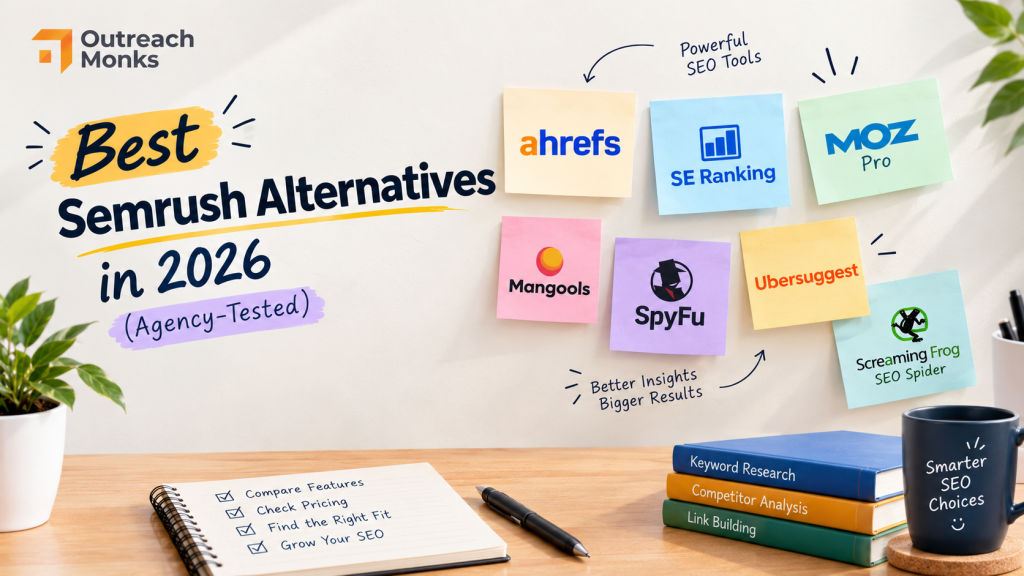
Quick answer: There is no single best Semrush alternative. Pick by what you actually use. Ahrefs suits backlink work, SE Ranking suits agencies, Moz Pro suits local SEO, and Screaming Frog handles technical crawling cheaply.
People usually look for an alternative after a renewal invoice or when seat costs start to climb.
Before you switch, open the Semrush reports you’ve viewed in the last 90 days. Most teams use four or five.
This list is written for agencies, so it covers team cost, client reporting, and what switching costs you. Where a price isn’t confirmed, we say so.
Outreach Monks sells link building services, not SEO software, and has no affiliate relationship with any tool below.
How We Compared
We looked at what each tool covers, what it costs at team size, client reporting, data depth, and the cost of switching.
We did not run an accuracy test of keyword volumes or backlink counts. Treat the “strongest point” lines as our assessment, not a benchmark.
Where prices come from: Ahrefs and Screaming Frog are from their own sites. Semrush is from a January 2026 third-party guide.
For the other tools, listings disagree, so we send you to the vendor’s pricing page instead of quoting a number.
The Seven at a Glance
For comparison, Semrush lists at about $139.95 (Pro), $249.95 (Guru), and $499.95 (Business) a month, with extra users at $45, $80, and $100 a month.
Why Teams Look Beyond Semrush
- Seats add up. Each extra user costs on top of the plan, so a five-person team pays much more than the headline price.
- You may not use the breadth. If you live in backlinks or keyword research, you are paying for tools you never open.
- Specific gaps. Some teams want a deeper backlink index or better local tracking.
Semrush still has the widest suite and strong paid search data.
If you use most of it, switching may not save money.
1. Ahrefs
Best for: Backlink-focused work and regular link audits
Ahrefs is the closest like-for-like swap for backlink work.
Lite includes 750 tracked keywords, 150 AI prompt checks a month, and 5 non-verified projects. There is also a $29 Starter plan, and a free version for sites you verify as yours.
Its pricing page says annual billing saves “up to 17%” while the page description says 20%, so check the current rate.
Best Fit
Teams whose main job is link building and audits in English-language markets.
2. SE Ranking
Best for: Agencies managing many client projects
SE Ranking is built with agencies in mind. Its report builder produces client-ready reports, so you rebuild fewer of them in other tools.
Third-party listings show very different entry prices, so confirm the current plan on its pricing page.
Best Fit
Agencies that want a full suite with lower per-seat cost.
3. Moz Pro

Best for: Local SEO and non-specialist users
Moz Pro is easy for non-specialists to read. It is the home of the Domain Authority metric many clients ask about, and it covers citations and map pack visibility for local work.
Listed prices differ across sources, so confirm before you buy.
Best Fit
Local businesses, small teams, and clients who ask about Domain Authority.
4. Mangools

Best for: Consultants and very small teams that mainly need keyword research
Mangools is easy for junior staff to learn. Limits are counted per day, so check the lookup allowance on the plan you pick.
Best Fit
Freelancers and small teams doing keyword research.
5. SpyFu

Best for: Competitor research and paid search history
SpyFu shows what a competitor has ranked and bid on over time, which helps in new business pitches.
The listing we checked shows a flat rate regardless of team size. Confirm that with SpyFu.
Best Fit
Agencies and marketers who pitch clients or watch competitors’ paid search.
6. Ubersuggest

Best for: Tight budgets and smaller clients
Ubersuggest gives directional data at a low price.
The depth may not hold up if a client questions the numbers, so use it for light reporting.
Best Fit
Small businesses and consultants who want a low-cost starting point.
7. Screaming Frog SEO Spider
Best for: Technical audits, as one half of a two-tool stack
Screaming Frog crawls on your own computer. The free version crawls up to 500 URLs.
Licences last one year. Discounts start at five licences (€235 each, down to €209 at 20+).
Paired with a research tool such as Ahrefs, it can replace much of what Semrush does.
Best Fit
Technical SEOs who want a crawler and are happy to use a second tool for research.
What Switching Costs You
- Rank tracking history doesn’t transfer. Clients will see trend lines reset. Export your history and run both tools side by side for one reporting cycle.
- Numbers will change. Different indexes give different volumes, difficulty scores, and backlink counts. Explain this to clients before it happens.
- Test on your own sites. Check whether the new tool finds backlinks and audit issues you already know about.
- Don’t switch mid-campaign. Finish active link building campaigns on your current tool so reports stay consistent.
Which One Should You Pick?
Final Thoughts
Choose by the reports you open, not by the longest feature list. A research tool plus a crawler covers most teams for less than a top Semrush plan.
Software shows you the gaps, but it can’t build authority. If the gap is backlinks, Outreach Monks builds links through manual outreach on real websites, from $99 per link with no retainer.
Frequently Asked Questions
Is there a free Semrush alternative?
Not a complete one. Google's Search Console reports how Google crawls, indexes, and serves your site, and Ahrefs' free version and Screaming Frog's 500-URL crawl cover a small site. Competitor data needs a paid tool.
What do agencies use instead of Semrush?
Mostly Ahrefs for link-heavy work or SE Ranking for client reporting, often with a third tool for competitor research.
Should I use one tool or two?
Most teams use two: a research platform plus a specialist such as a crawler or a competitor tool.
Ahrefs or Semrush for backlinks?
Ahrefs is the usual pick for backlink work, although Semrush has narrowed the gap.
Are cheaper tools as accurate?
Often less so, especially for backlinks and non-English keyword volumes. Accuracy matters most when you report absolute numbers to clients.
