
Link prospecting is the part of link building that never makes it into the case study. It is the unglamorous work of deciding which sites are worth pitching before you write a single email, and it quietly decides everything that happens afterwards. A brilliant pitch sent to a site that was never going to link to you is still a wasted hour, which is why the tool you use to build the list matters more than the template you use to send it.
Short on time. Ahrefs if you want the deepest competitor backlink index to mine. Semrush if it is already in your stack and you want multi competitor link gaps. Pitchbox if you run outreach at agency volume and want discovery and sending in one place. BuzzStream if you want outreach management without the agency price tag. Hunter if your list is already built and you just need real people to email.
What Makes a Prospecting Tool Actually Good
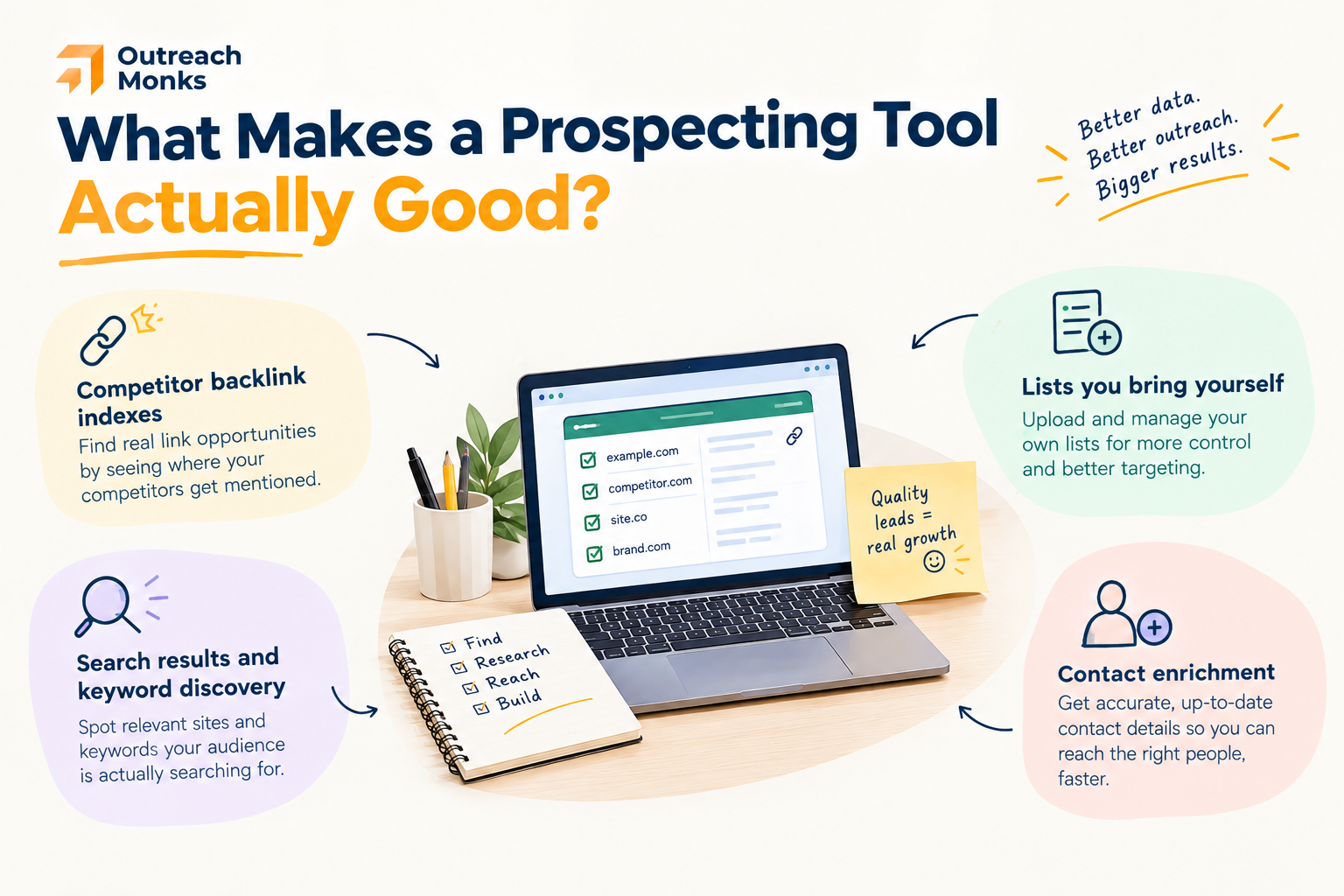
Most comparisons rank these tools on feature count. There is a narrower question that predicts list quality far better: where does this tool get its prospects from? The source decides the quality of a list long before any filter touches it, and there are really only four sources in this market.
- Competitor backlink indexes: Someone already linked to a site like yours, which proves the site accepts outside content. The catch is that you inherit your competitors’ strategy, including their mistakes.
- Search results and keyword discovery: Much wider reach than competitor links, because it surfaces sites nobody in your niche has pitched yet. A site that ranks well, though, is not automatically a site that publishes contributors.
- Lists you bring yourself: The tool does not discover anything. It organises, dedupes and tracks the relationship once you have the names.
- Contact enrichment: Not prospecting at all, strictly speaking. It turns a list of domains into a list of people you can actually reach, which is where plenty of workflows quietly break.
Once you know the source, the rest of the checklist is quick. You want domain level metrics you can filter on, contact data that is accurate enough to be worth sending to, filtering deep enough to cut a 4,000 row export down to something a human can review, a clean export or CRM handoff, and some way to spot the sites that look fine on paper and are quietly selling links to anyone who asks. That last one is the hardest to automate and the most expensive to get wrong.
1. Ahrefs: The Deepest Index to Mine
| Prospects Come From | Competitor backlink profiles, link intersect, Content Explorer |
| Entry Price | Lite at $129 per month. Standard $249, Advanced $449, Enterprise $1,499 |
| Free Way In | Ahrefs Free gives limited Site Explorer and Site Audit access for a site you verify as your own |
| Best Fit | Anyone whose prospecting starts with the question “who links to my competitors” |
Ahrefs is the tool most link builders reach for here, and the reason is unglamorous: the index is enormous and it refreshes quickly. You can filter by domain rating, organic traffic, whether the link is dofollow, the anchor used, and the country the traffic comes from.
The lost and new backlink reports are underrated for prospecting, because a site that linked to a competitor last month is a site with a live editorial process right now, not one that published a roundup in 2019 and forgot about it. If you work on SaaS link building, the overlap reports are usually the fastest route to a list worth pitching.
The honest limitation is that competitor backlink mining is inherently derivative. You will find what your competitors found, which means you compete for the same placements and, if their link profile is thin or built on low quality sites, you inherit that too. Treat the export as raw material rather than a list.
Verdict: The best starting point for most prospecting workflows, as long as you remember you are copying someone else’s homework.
2. Semrush: Strong If It Is Already in Your Stack
| Prospects Come From | Backlink Gap across several competitors at once, plus the built-in Link Building Tool |
| Entry Price | Pro around $139.95 per month. Guru around $249.95, Business around $499.95 |
| Free Way In | A limited free account and a trial that asks for a card and renews unless you cancel |
| Best Fit | Teams already paying for Semrush who do not want a second subscription |
Semrush does the same core job as Ahrefs with a different emphasis. Backlink Gap is the piece worth your attention, because it compares up to five domains in one view and sorts by how many of your competitors a site links to. A domain linking to four of your five rivals and none of them to you is about as warm as a cold prospect gets.
The Link Building Tool then takes those prospects and gives you a basic pipeline to work them through, including a simple outreach inbox. It is not a serious replacement for a dedicated outreach platform, and anyone sending at volume will outgrow it quickly, but it closes the loop well enough for a small in house team running a handful of campaigns.
The usual caveat applies: off page work lives or dies on follow up, and a tool that makes follow up awkward will cost you placements you had already earned.
Where Semrush genuinely wins is breadth. If the same subscription is already covering your keyword research, rank tracking and site audits, adding a dedicated prospecting tool on top is a hard spend to justify. If backlink work is the main thing you do all day, most specialists still prefer the depth of a dedicated index.
Verdict: Excellent value as part of a suite you already own. Rarely the right purchase on prospecting merit alone.
3. Pitchbox: Built for Volume, Priced Like It
| Prospects Come From | Keyword and search-driven discovery inside the platform, plus imported lists |
| Entry Price | Pro at $300 per month, or $210 on annual billing. Advanced $600, Scale $1,200 |
| Free Way In | No self-serve trial. Trials exist but run through a demo call |
| Best Fit | Agencies and in-house teams sending thousands of emails a month |
Two details deserve more attention than they usually get. First, every plan carries a one year commitment, whichever billing frequency you choose, so this is a decision about your next twelve months rather than your next thirty days. Second, the expert led implementation that is included on annual billing is otherwise priced from $2,000 on Pro up to $4,000 on Scale.
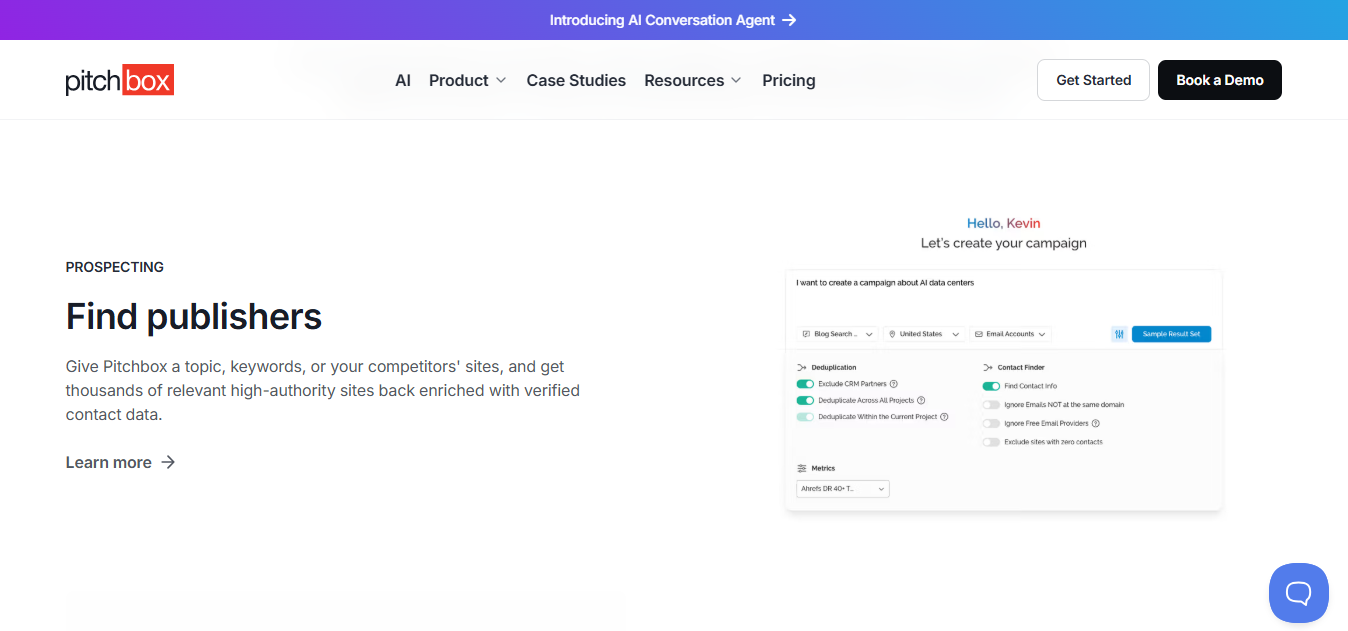
Budget for the platform honestly, not just the headline figure. If the maths stops making sense at that level, white label link building is often the cheaper route to the same output, because the volume lives on someone else’s subscription.
The other thing to accept is that automation amplifies whatever you feed it. Point a well configured Pitchbox campaign at a poorly qualified list and you will send a thousand irrelevant pitches with impressive efficiency. The qualification step does not get easier because the sending got faster.
Verdict: The right tool once outreach is a function rather than a task, provided your list quality already justifies the volume.
4. BuzzStream: Outreach Management Without the Agency Price
| Prospects Come From | Mostly lists you supply. Prospecting searches exist but are tightly capped on lower plans |
| Entry Price | Starter at $49 per month for 2,000 credits. Growth $149, Scale $299 |
| Free Way In | No clearly published free tier. Trial terms are not stated on the pricing page |
| Best Fit | Small teams who already know who they want to pitch and need to stay organised |
Read the plan limits closely before you buy, because they tell you what the tool is really for. Starter includes 500 contacts and roughly 30 prospecting searches a month, which is not a prospecting budget in any meaningful sense. Growth moves you to 25,000 contacts and about 250 searches, and Professional to 100,000 contacts and roughly 1,000 searches.

In other words, the cheap plan is for managing relationships you already have, not building new ones. That is a perfectly good job, especially for a team maintaining editorial links and long running publisher relationships, as long as nobody expects it to fill the pipeline.
Pair it with a proper index for discovery and it earns its place at a fraction of what the all in one platforms cost. It also keeps a usable record of placements over time, which matters more than people expect once link decay starts quietly removing links you paid real money to earn.
Verdict: A sharp, affordable layer for managing outreach. Do not buy the entry plan expecting it to find prospects for you.
5. Hunter: The Step Everyone Skips
| Prospects Come From | Nowhere. It finds people at domains you already have |
| Entry Price | Starter at $49 per month. Growth $174, Professional $424, Custom from $999 |
| Free Way In | A genuine free tier with 50 credits a month, which is enough to test properly |
| Best Fit | Anyone whose prospect list is ready and whose bounce rate is embarrassing |
You give it a domain and it returns the email addresses it knows for that domain, with a confidence score, plus verification so you can drop the dead ones before you send. The credit model is worth understanding: finding an email costs one credit and verifying one costs half a credit, so the free 50 credits a month genuinely let you test accuracy on your own niche rather than on a vendor demo.

Do exactly that, because contact databases vary enormously by industry and country, and the only accuracy figure that matters is the one you measure on sites you actually want to pitch. Whatever you find, send to a named person rather than a generic inbox, and keep your outreach templates short enough that the person can tell within two lines what you are asking for.
The limitation is baked into the design. If your list is weak, Hunter will help you reach the wrong people faster and more reliably. It is the last mile of a prospecting workflow, never the whole thing.
Verdict: Not a prospecting tool, and still hard to run a campaign without something that does this job.
Quick Comparison of the Five Tools
Here is how the five line up side by side, so you can shortlist by budget and job before going back to whichever breakdowns above apply to you.
| Tool | Prospects Come From | Entry Price | Free Way In |
|---|---|---|---|
| Ahrefs | Competitor backlink index | $129 per month (Lite) | Limited free access to your own verified site |
| Semrush | Backlink Gap across competitors | About $139.95 per month (Pro) | Limited free account, trial needs a card |
| Pitchbox | Search and keyword discovery | $300 per month, or $210 annual | Trial via demo call only |
| BuzzStream | Lists you supply | $49 per month (Starter) | Not clearly published |
| Hunter | Contacts only, no discovery | $49 per month (Starter) | 50 credits a month, free |
Pricing and plan limits change often, and some figures here come from third party trackers rather than vendor pages. Confirm current numbers on the vendor site before you buy.
How to Prospect Well, Whatever Tool You Use
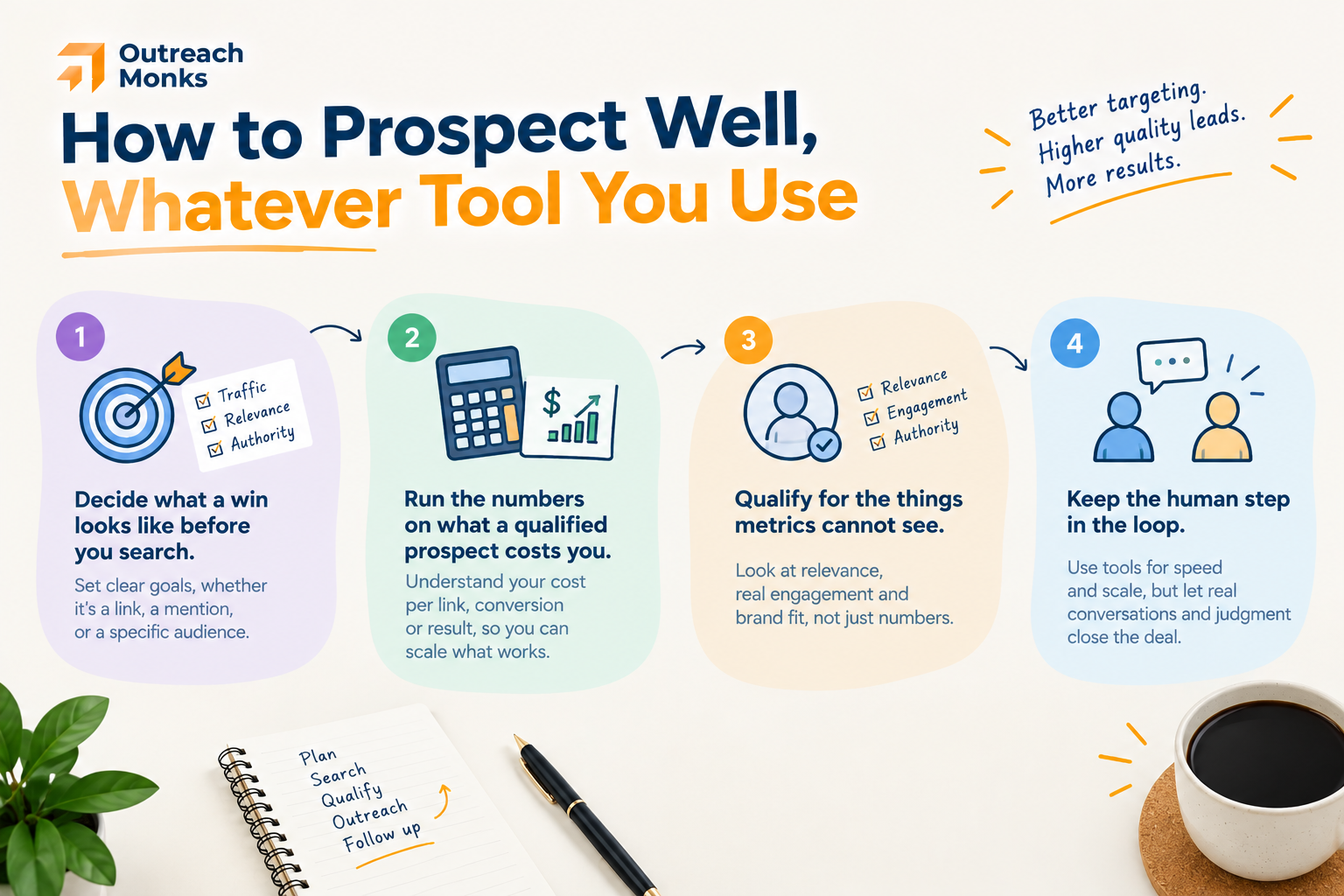
No tool on this list outputs a list you should pitch. Every one of them outputs raw material. The difference between a campaign that lands links and one that burns a month sits in what you do between the export and the first email.
1. Decide what a win looks like before you search
A prospect list is only as good as the definition it was built against. Before you open a tool, write down the kind of site you want a link from: the topics it covers, roughly the audience size, the countries that matter, and the pages on your own site the link should point at.
This sounds like process for its own sake until you watch two people prospect the same niche with different definitions and produce lists with almost no overlap. Being specific about who you are actually trying to reach is what turns a metric filter into a relevance filter.
2. Run the numbers on what a qualified prospect costs you
Here is the calculation almost nobody does. Take BuzzStream Starter at $49 a month with roughly 30 prospecting searches. If each search surfaces 20 domains, that is 600 raw prospects. If 15 percent survive a real relevance and quality check, which is generous, you end up with about 90 usable prospects, or roughly 54 cents each in tool cost.
Now price the human part. Reviewing 600 domains at three minutes each is 30 hours of work. At any realistic hourly rate, the subscription is the cheapest line on the page by a wide margin. That single piece of arithmetic should change how you shop: stop optimising for the cheapest tool and start optimising for the one that wastes the least of your reviewing time.
3. Qualify for the things metrics cannot see
Domain rating tells you about a site’s backlink profile. It tells you nothing about whether a human editor will ever read your email, or whether a link there will still be worth having in a year. These are the red flags worth checking by hand, and none of them show up in a metrics column.
- Topic drift. A site publishing crypto, CBD, dentistry and casino content in the same month is not a publisher with broad interests. It is selling space.
- A price list behind the contributor page. A “write for us” page is fine. A published rate card for a dofollow link means you are buying placement, not earning it.
- Outbound anchor patterns. If most posts carry three or four commercial exact match anchors to unrelated businesses, the pattern is obvious to you and it is obvious to Google.
- Traffic that does not match the audience. A site supposedly serving US small businesses, with traffic almost entirely from countries where it does no business, is worth a much closer look.
- No named authors, or authors who exist nowhere else. Thin or invented author pages are one of the most reliable signals that nobody is editing anything.
- A metrics spike with no explanation. Authority that appeared suddenly, with no content or coverage behind it, usually has a history worth checking in the Wayback Machine.
If several of these land at once, you are most likely looking at a site built to sell links rather than serve readers, and a link from it belongs in the unnatural links column rather than your campaign. The distinction between natural and unnatural backlinks is not academic. It is the difference between an asset and a liability you will pay someone to remove later. The same logic rules out anything resembling a link wheel, however well disguised the network looks from the outside.
4. Keep the human step in the loop
Every tool here will happily hand you a thousand rows. The teams that get results treat that export as a starting point, review the survivors individually, and pitch fewer sites properly. It is slower per prospect and far better per placement. This is the whole premise behind manual outreach as a method, and it is why a reviewed list of 40 sites routinely beats an automated blast to 400.
It is also the reason Outreach Monks has never run outreach any other way: every prospect that reaches a client’s pipeline has been looked at by a person first, not just filtered by a script. If you would rather not build that review capacity in house, managed link building and guest posting services exist precisely because the qualification work is the expensive part, not the sending.
The Bottom Line
Pick your tool by the job you actually need done. If you need to discover prospects, you need an index, which means Ahrefs or Semrush depending on what you already pay for. If you need to work a large pipeline without losing follow ups, you need an outreach platform, and Pitchbox is the serious option once the volume justifies the commitment.
If you need to stay organised on a modest budget, BuzzStream does that well. If your list is built and your emails are bouncing, you need a contact tool, and Hunter has a free tier big enough to prove whether it works in your niche.
What none of them will do is tell you whether a site deserves your pitch. That judgment stays with you, and it is where the returns actually live. The best prospecting setup is a decent index, a sane way to track what you sent, and someone willing to look at the sites before the emails go out. Get that combination right and the anchor text strategy, the brand mentions and everything downstream become much easier problems.
Frequently Asked Questions
What is link prospecting in SEO?
Link prospecting is the process of finding and qualifying websites that could realistically link to you, before any outreach begins. It covers discovering candidate sites, checking them for relevance and quality, and finding the right person to contact. It is the research half of link building, and it determines the ceiling on everything that follows.
What is the difference between link prospecting and link building?
Prospecting is deciding who to ask. Link building is the whole process, including the pitch, the content, the negotiation and the placement. Prospecting is the first stage, and it is the one most often rushed, which is why so many campaigns produce a lot of sent email and very few links.
Can free tools replace paid link prospecting software?
For a small, occasional campaign, partly. Google search operators, free browser extensions, Hunter's free credits and a spreadsheet will get you a workable list if your volume is low and your time is cheap. What you give up is speed, filtering depth and historical backlink data, and the cost shows up as hours rather than dollars. Past roughly a few dozen prospects a month, a paid index pays for itself in review time saved.
How do you know if a prospect is actually worth pursuing?
Check three things in order. Does the site publish content your audience would plausibly read, does it link out editorially to businesses like yours, and does it show any of the signals of a site that sells placements rather than earns them? Metrics come fourth, not first. A relevant site with modest numbers is usually worth more than a high authority site with no topical connection to you.
Is link prospecting still effective in 2026 with AI search growing?
It matters more, not less, though the target has widened. AI systems lean heavily on the same signals of authority and consensus that links represent, and they cite sources that are already referenced across credible sites. That makes prospecting for genuinely relevant, genuinely read publications more valuable than ever, and it makes high volume placements on link farms less useful than they already were. The method holds. The quality bar has simply gone up.
